Ch. 6 - Applications of Integration
Briggs - Calculus: Early Transcendentals 3rd Edition
Briggs3rd EditionCalculus: Early TranscendentalsISBN: 9780136847243Not the one you use?Change textbook
Chapter 6, Problem 6.3.71

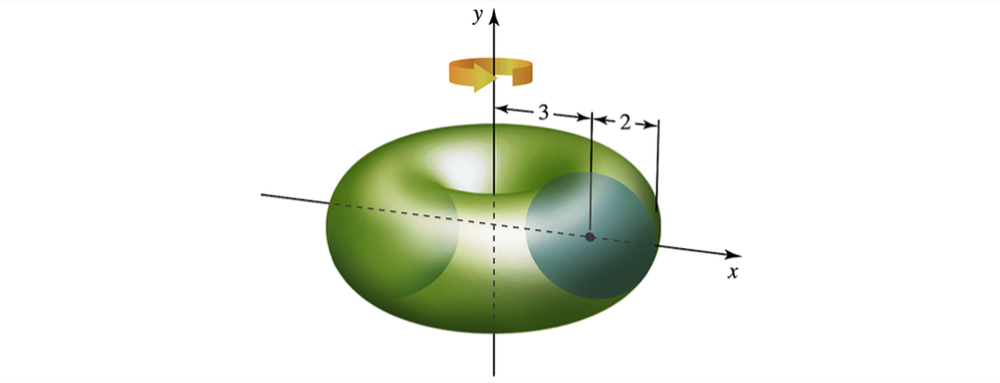
Find the volume of the torus formed when the circle of radius 2 centered at (3, 0) is revolved about the y-axis. Use geometry to evaluate the integral.
<IMAGE>

Verified step by step guidance
1
The torus is formed by revolving a circle of radius 2, centered at (3, 0), about the y-axis. To calculate the volume, we use the formula for the volume of a solid of revolution. Specifically, we use the washer method, which involves integrating the area of washers formed by the revolution.
The formula for the volume of a torus is derived from the washer method: \( V = 2\pi \int_{a}^{b} R(x)r(x) \, dx \), where \( R(x) \) is the distance from the center of the torus to the axis of revolution (the y-axis), and \( r(x) \) is the radius of the revolving circle.
In this case, the center of the circle is at (3, 0), so the distance from the center of the torus to the y-axis is \( R = 3 \). The radius of the revolving circle is \( r = 2 \).
Using geometry, the volume of the torus can be expressed as \( V = 2\pi R \cdot \pi r^2 \), where \( R \) is the major radius (distance from the center of the torus to the axis of revolution) and \( r \) is the minor radius (radius of the revolving circle).
Substitute \( R = 3 \) and \( r = 2 \) into the formula to get \( V = 2\pi (3) \cdot \pi (2)^2 \). Simplify this expression to find the volume of the torus.

Verified video answer for a similar problem:

This video solution was recommended by our tutors as helpful for the problem above.
Video duration:
5m
Was this helpful?

Key Concepts

Here are the essential concepts you must grasp in order to answer the question correctly.

Volume of Revolution

The volume of revolution is calculated by rotating a two-dimensional shape around an axis, creating a three-dimensional object. The volume can be determined using integral calculus, specifically the disk or washer method, depending on the shape's geometry. In this case, the circle's revolution around the y-axis forms a torus, and the volume can be computed by integrating the area of circular cross-sections.
Recommended video:
04:48
Finding Volume Using Disks

Torus Geometry

A torus is a doughnut-shaped surface generated by revolving a circle around an external axis that does not intersect the circle. The key parameters of a torus include the radius of the circle (r) and the distance from the center of the circle to the axis of rotation (R). For the given problem, the circle has a radius of 2 and is centered at (3, 0), leading to specific values for R and r that are essential for calculating the volume.
Recommended video:
06:35
Changing Geometries

Integral Calculus

Integral calculus is a branch of mathematics focused on the accumulation of quantities, such as areas under curves or volumes of solids. In this context, it is used to evaluate the volume of the torus by setting up an integral that accounts for the circular cross-sections formed during the revolution. Understanding how to set up and evaluate these integrals is crucial for solving problems related to volumes of solids of revolution.
Recommended video:
06:11
Fundamental Theorem of Calculus Part 1