Ch. 6 - Applications of Integration
Briggs - Calculus: Early Transcendentals 3rd Edition
Briggs3rd EditionCalculus: Early TranscendentalsISBN: 9780136847243Not the one you use?Change textbook
Chapter 6, Problem 6.3.60

The region R is bounded by the graph of f(x)=2x(2−x) and the x-axis. Which is greater, the volume of the solid generated when R is revolved about the line y=2 or the volume of the solid generated when R is revolved about the line y=0? Use integration to justify your answer.

Verified step by step guidance
1
Step 1: Identify the region R. The region R is bounded by the graph of f(x) = 2x(2 − x) and the x-axis. To find the bounds of integration, solve f(x) = 0. This gives x = 0 and x = 2 as the limits of integration.
Step 2: Set up the volume integral for the solid generated when R is revolved about the line y = 2. The distance from the line y = 2 to the curve is (2 − f(x)), and the distance from the line y = 2 to the x-axis is 2. Use the washer method to compute the volume: \( V = \pi \int_{0}^{2} \left[ (2)^2 - (2 - f(x))^2 \right] dx \).
Step 3: Expand and simplify the integrand for the volume about y = 2. Substitute f(x) = 2x(2 − x) into the expression and simplify \( (2 - f(x))^2 \). This will involve expanding \( (2 - 2x(2 − x))^2 \) and combining terms.
Step 4: Set up the volume integral for the solid generated when R is revolved about the line y = 0. The distance from the line y = 0 to the curve is f(x). Use the disk method to compute the volume: \( V = \pi \int_{0}^{2} [f(x)]^2 dx \). Substitute f(x) = 2x(2 − x) and simplify \( [f(x)]^2 \).
Step 5: Compare the two volumes. Evaluate both integrals (without calculating the final numerical values here) and analyze the expressions to determine which volume is greater. The comparison depends on the relative contributions of the terms in the integrals for the two setups.

Verified video answer for a similar problem:

This video solution was recommended by our tutors as helpful for the problem above.
Video duration:
6m
Was this helpful?

Key Concepts

Here are the essential concepts you must grasp in order to answer the question correctly.

Volume of Revolution

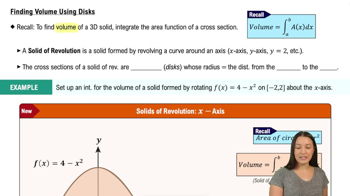
The volume of revolution refers to the volume of a solid formed by rotating a region around a specified axis. This is typically calculated using the disk or washer method, where the volume is determined by integrating the area of circular cross-sections perpendicular to the axis of rotation. Understanding how to set up these integrals is crucial for solving problems involving solids of revolution.
Recommended video:
04:48
Finding Volume Using Disks

Definite Integrals

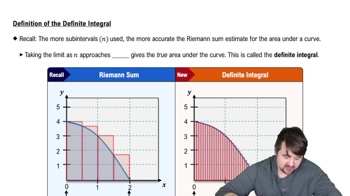
Definite integrals are used to calculate the area under a curve between two points on the x-axis. In the context of volume of revolution, they help determine the total volume by integrating the area of the cross-sections. Mastery of evaluating definite integrals is essential for accurately computing the volumes of solids generated by revolving regions around axes.
Recommended video:
05:43
Definition of the Definite Integral

Comparison of Volumes

Comparing volumes generated by revolving a region around different axes involves calculating the volumes separately and then analyzing the results. This requires a clear understanding of how the axis of rotation affects the dimensions of the resulting solid. By setting up and evaluating the appropriate integrals for each case, one can determine which volume is greater and justify the conclusion mathematically.
Recommended video:
04:48
Finding Volume Using Disks