
Ch. 6 - Applications of Integration
Briggs - Calculus: Early Transcendentals 3rd Edition
Briggs3rd EditionCalculus: Early TranscendentalsISBN: 9780136847243Not the one you use?Change textbook
Chapter 6, Problem 6.6.7

Find the area of the surface generated when the given curve is revolved about the given axis.


y=3x+4, for 0≤x≤6; about the x-axis

Verified step by step guidance
1
Step 1: Recall the formula for the surface area of a curve revolved about the x-axis: A = 2π ∫[a,b] y √(1 + (dy/dx)2) dx. Here, y is the function being revolved, and dy/dx is its derivative.
Step 2: Identify the function y = 3x + 4 and compute its derivative. The derivative of y with respect to x is dy/dx = 3.
Step 3: Substitute y = 3x + 4 and dy/dx = 3 into the formula. The integral becomes: A = 2π ∫[0,6] (3x + 4) √(1 + 32) dx.
Step 4: Simplify the square root term. Since √(1 + 32) = √10, the integral simplifies to: A = 2π √10 ∫[0,6] (3x + 4) dx.
Step 5: Evaluate the integral ∫[0,6] (3x + 4) dx. Break it into two parts: ∫[0,6] 3x dx and ∫[0,6] 4 dx. Compute each part separately, then multiply the result by 2π √10 to find the surface area.

Verified video answer for a similar problem:

This video solution was recommended by our tutors as helpful for the problem above.
Video duration:
4m
Was this helpful?

Key Concepts

Here are the essential concepts you must grasp in order to answer the question correctly.

Surface Area of Revolution

The surface area of revolution is calculated by revolving a curve around an axis. The formula involves integrating the circumference of infinitesimally small circular sections formed by the revolution. For a function y = f(x) revolved around the x-axis, the surface area S can be expressed as S = 2π ∫[a to b] f(x) √(1 + (f'(x))^2) dx, where f'(x) is the derivative of f(x).
Recommended video:
09:07
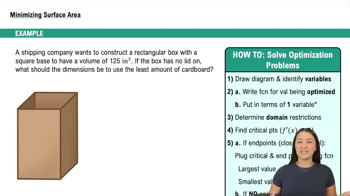
Example 1: Minimizing Surface Area

Definite Integral

A definite integral calculates the accumulation of quantities, such as area under a curve, over a specific interval [a, b]. In the context of surface area, it helps determine the total surface area generated by the curve from x = 0 to x = 6. The result of a definite integral is a numerical value representing the total area or volume, depending on the application.
Recommended video:
05:43
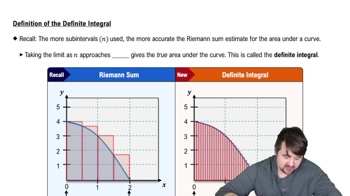
Definition of the Definite Integral

Parametric Representation of Curves

In some cases, curves can be represented parametrically, where both x and y are expressed as functions of a third variable, usually t. However, for the given linear function y = 3x + 4, a simple Cartesian representation suffices. Understanding how to manipulate and differentiate these representations is crucial for applying calculus concepts effectively in problems involving curves and their properties.
Recommended video:
06:49
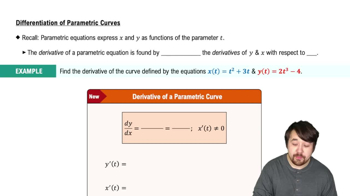
Differentiation of Parametric Curves