Ch. 6 - Applications of Integration
Briggs - Calculus: Early Transcendentals 3rd Edition
Briggs3rd EditionCalculus: Early TranscendentalsISBN: 9780136847243Not the one you use?Change textbook
Chapter 6, Problem 6.4.28

9-34. Shell method Let R be the region bounded by the following curves. Use the shell method to find the volume of the solid generated when R is revolved about indicated axis. 


{Use of Tech} y = √sin^−1x,y = √π/2, and x=0; about the x-axis

Verified step by step guidance
1
First, identify the region R bounded by the curves: \( y = \sqrt{\sin^{-1} x} \), \( y = \sqrt{\frac{\pi}{2}} \), and \( x = 0 \). Understand that \( \sin^{-1} x \) is the inverse sine function, also called arcsin, which outputs values in radians.
Since the solid is generated by revolving the region about the x-axis, and the shell method involves cylindrical shells formed by revolving vertical slices, consider using horizontal slices instead. However, the shell method is typically easier when revolving around the x-axis if we integrate with respect to \( y \).
Express \( x \) in terms of \( y \) from the equation \( y = \sqrt{\sin^{-1} x} \). Square both sides to get \( y^2 = \sin^{-1} x \), then solve for \( x \) as \( x = \sin(y^2) \). This will be the radius function for the shells.
Set up the volume integral using the shell method formula for revolution about the x-axis: \(\n\[\n\)\[ V = 2\pi \int_{a}^{b} (\text{radius}) \times (\text{height}) \, dy \]\(\n\]\nHere\), the radius is the distance from the x-axis to the shell, which is \( y \), and the height is the horizontal length of the shell, which is \( x = \sin(y^2) - 0 = \sin(y^2) \). The limits of integration \( a \) and \( b \) correspond to the y-values bounding the region, from \( y = 0 \) to \( y = \sqrt{\frac{\pi}{2}} \).
Write the integral explicitly: \(\n\[\n\)\[ V = 2\pi \int_{0}^{\sqrt{\frac{\pi}{2}}} y \cdot \sin(y^2) \, dy \]\(\n\]\nThis\) integral represents the volume of the solid generated by revolving the region about the x-axis using the shell method. The next step would be to evaluate this integral, possibly using substitution, but as per instructions, we stop here.

Verified video answer for a similar problem:

This video solution was recommended by our tutors as helpful for the problem above.
Video duration:
7m
Was this helpful?

Key Concepts

Here are the essential concepts you must grasp in order to answer the question correctly.

Shell Method for Volume

The shell method calculates the volume of a solid of revolution by integrating cylindrical shells. Each shell's volume is approximated by its circumference times height times thickness. This method is especially useful when the axis of rotation is parallel to the axis of the variable of integration.
Recommended video:
04:48
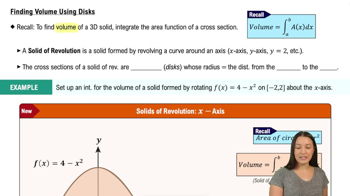
Finding Volume Using Disks

Region Bounded by Curves

Understanding the region bounded by the given curves is essential to set correct integration limits. Here, the region is bounded by y = √(sin⁻¹x), y = √(π/2), and x = 0, which defines the shape and size of the area to be revolved around the x-axis.
Recommended video:
05:06
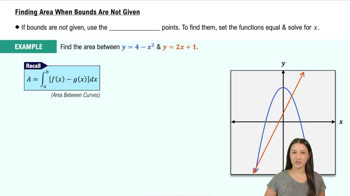
Finding Area When Bounds Are Not Given

Revolution About the x-axis

Revolving a region about the x-axis means rotating it horizontally, which affects how the shells are formed. For the shell method, the radius of each shell is the distance from the shell to the axis of rotation, and the height corresponds to the function values along the axis perpendicular to the x-axis.
Recommended video:
06:30
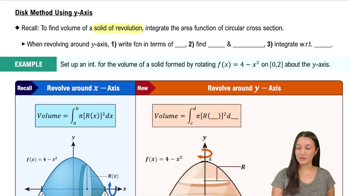
Disk Method Using y-Axis