
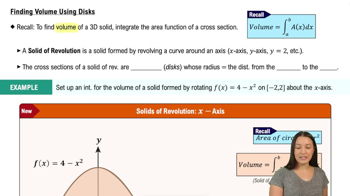
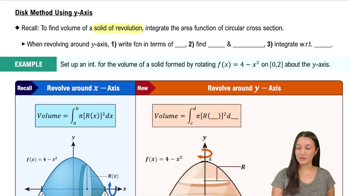
Assume f and g are continuous, with f(x) ≥ g(x) ≥ 0 on [a, b]. The region bounded by the graphs of f and g and the lines x=a and x=b is revolved about the y-axis. Write the integral given by the shell method that equals the volume of the resulting solid.
For the following regions R, determine which is greater—the volume of the solid generated when R is revolved about the x-axis or about the y-axis.
R is bounded by y=1−x^3, the x-axis, and the y-axis.
Verified step by step guidance
Verified video answer for a similar problem:
Key Concepts
Volume of Revolution
Disk and Washer Methods
Bounded Regions
9–20. Arc length calculations Find the arc length of the following curves on the given interval.
y = −8x−3 on [−2, 6] (Use calculus.)
9–12. Consider the cylindrical tank in Example 4 that has a height of 10 m and a radius of 5 m. Recall that if the tank is full of water, then ∫₀¹⁰ 25 π ρg(15−y) dy equals the work required to pump all the water out of the tank, through an outflow pipe that is 15 m above the bottom of the tank. Revise this work integral for the following scenarios. (Do not evaluate the integrals.)
The work required to empty the top half of the tank
Leaky Bucket A 1-kg bucket resting on the ground contains 3 kg of water. How much work is required to raise the bucket vertically a distance of 10 m if water leaks out of the bucket at a constant rate of 1/5 kg/m? Assume the weight of the rope used to raise the bucket is negligible. (Hint: Use the definition of work, W = ∫a^bF(y) dy, where F is the variable force required to lift an object along a vertical line from y=a to y=b.)
Find the area of the region described in the following exercises.
The region bounded by x=y(y−1) and y=x/3
9-34. Shell method Let R be the region bounded by the following curves. Use the shell method to find the volume of the solid generated when R is revolved about indicated axis.
{Use of Tech} y = √sin^−1x,y = √π/2, and x=0; about the x-axis
