Ch. 6 - Applications of Integration
Briggs - Calculus: Early Transcendentals 3rd Edition
Briggs3rd EditionCalculus: Early TranscendentalsISBN: 9780136847243Not the one you use?Change textbook
Chapter 6, Problem 6.5.9

9–20. Arc length calculations Find the arc length of the following curves on the given interval.
y = −8x−3 on [−2, 6] (Use calculus.)

Verified step by step guidance
1
Identify the function given: \(y = -8x - 3\) and the interval \([-2, 6]\) over which we want to find the arc length.
Recall the formula for the arc length \(L\) of a curve \(y = f(x)\) from \(x = a\) to \(x = b\): \(L = \int_{a}^{b} \sqrt{1 + \left(\frac{dy}{dx}\right)^2} \, dx\)
Compute the derivative \(\frac{dy}{dx}\) of the function \(y = -8x - 3\). Since this is a linear function, find \(\frac{dy}{dx}\) explicitly.
Substitute \(\frac{dy}{dx}\) into the arc length formula to get the integrand \(\sqrt{1 + \left(\frac{dy}{dx}\right)^2}\), which will be a constant expression because the derivative is constant.
Evaluate the definite integral \(\int_{-2}^{6} \sqrt{1 + \left(\frac{dy}{dx}\right)^2} \, dx\) by integrating the constant integrand over the interval length \((6 - (-2))\).

Verified video answer for a similar problem:

This video solution was recommended by our tutors as helpful for the problem above.
Video duration:
2m
Was this helpful?

Key Concepts

Here are the essential concepts you must grasp in order to answer the question correctly.

Arc Length Formula

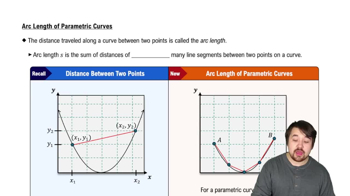
The arc length of a curve y = f(x) from x = a to x = b is found using the integral formula L = ∫_a^b √(1 + (dy/dx)^2) dx. This formula sums the lengths of infinitesimal line segments along the curve, providing the total distance traveled along it.
Recommended video:
06:29
Arc Length of Parametric Curves

Derivative of the Function

To apply the arc length formula, you need the derivative dy/dx of the function y = f(x). The derivative represents the slope of the curve at any point, and its square is used inside the square root to account for the curve's steepness in the length calculation.
Recommended video:
06:30
Derivatives of Other Trig Functions

Definite Integration

Calculating arc length requires evaluating a definite integral over the given interval [a, b]. This process involves integrating the expression √(1 + (dy/dx)^2) with respect to x, which may require algebraic simplification or substitution to solve.
Recommended video:
05:43
Definition of the Definite Integral
Related Practice
Textbook Question

Assume f is a nonnegative function with a continuous first derivative on [a, b]. The curve y=f(x) on [a, b] is revolved about the x-axis. Explain how to find the area of the surface that is generated.

Textbook Question

Assume f and g are continuous, with f(x) ≥ g(x) ≥ 0 on [a, b]. The region bounded by the graphs of f and g and the lines x=a and x=b is revolved about the y-axis. Write the integral given by the shell method that equals the volume of the resulting solid.

1
views
Textbook Question

9–12. Consider the cylindrical tank in Example 4 that has a height of 10 m and a radius of 5 m. Recall that if the tank is full of water, then ∫₀¹⁰ 25 π ρg(15−y) dy equals the work required to pump all the water out of the tank, through an outflow pipe that is 15 m above the bottom of the tank. Revise this work integral for the following scenarios. (Do not evaluate the integrals.)


The work required to empty the top half of the tank

1
views
Textbook Question

Leaky Bucket A 1-kg bucket resting on the ground contains 3 kg of water. How much work is required to raise the bucket vertically a distance of 10 m if water leaks out of the bucket at a constant rate of 1/5 kg/m? Assume the weight of the rope used to raise the bucket is negligible. (Hint: Use the definition of work, W = ∫a^bF(y) dy, where F is the variable force required to lift an object along a vertical line from y=a to y=b.)

1
views
Textbook Question

For the following regions R, determine which is greater—the volume of the solid generated when R is revolved about the x-axis or about the y-axis.


R is bounded by y=1−x^3, the x-axis, and the y-axis.

1
views
Textbook Question

Let R be the region bounded by the following curves. Find the volume of the solid generated when R is revolved about the given line.


x=2−secy,x=2,y=π/3, and y=0; about x=2

1
views