Ch. 6 - Applications of Integration
Briggs - Calculus: Early Transcendentals 3rd Edition
Briggs3rd EditionCalculus: Early TranscendentalsISBN: 9780136847243Not the one you use?Change textbook
Chapter 6, Problem 6.3.51

Let R be the region bounded by the following curves. Find the volume of the solid generated when R is revolved about the given line.


x=2−secy,x=2,y=π/3, and y=0; about x=2

Verified step by step guidance
1
Step 1: Identify the region R bounded by the given curves. The region is enclosed by x = 2 - sec(y), x = 2, y = π/3, and y = 0. Visualize the region by sketching the curves in the xy-plane.
Step 2: Recognize that the solid is generated by revolving the region R about the line x = 2. Use the method of cylindrical shells or the washer method to set up the integral for the volume.
Step 3: For the washer method, calculate the outer radius and inner radius of the washers. The outer radius is the distance from x = 2 to x = 2, which is 0. The inner radius is the distance from x = 2 to x = 2 - sec(y), which is sec(y).
Step 4: Write the volume integral using the washer method. The volume is given by: y=0y=π3π(sec2)dy
Step 5: Evaluate the integral to find the volume. Simplify the integrand and compute the definite integral over the interval y = 0 to y = π/3. This will yield the final volume of the solid.

Verified video answer for a similar problem:

This video solution was recommended by our tutors as helpful for the problem above.
Video duration:
3m
Was this helpful?

Key Concepts

Here are the essential concepts you must grasp in order to answer the question correctly.

Volume of Revolution

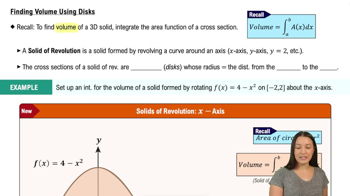
The volume of revolution refers to the volume of a solid formed by rotating a two-dimensional area around a specified axis. This is typically calculated using methods such as the disk method or the washer method, which involve integrating the area of circular cross-sections perpendicular to the axis of rotation.
Recommended video:
04:48
Finding Volume Using Disks

Integration

Integration is a fundamental concept in calculus that involves finding the accumulated area under a curve. In the context of volume of revolution, integration is used to sum up the infinitesimally small volumes of the disks or washers formed by the rotation of the region around the axis, leading to the total volume of the solid.
Recommended video:
06:18
Integration by Parts for Definite Integrals

Bounded Region

A bounded region in calculus is a specific area enclosed by curves or lines on a graph. In this problem, the region R is defined by the curves x=2−secy, x=2, y=π/3, and y=0, which sets the limits for integration when calculating the volume of the solid formed by revolving this region around the line x=2.
Recommended video:
07:45
Area of Polar Regions
Related Practice
Textbook Question

Assume f is a nonnegative function with a continuous first derivative on [a, b]. The curve y=f(x) on [a, b] is revolved about the x-axis. Explain how to find the area of the surface that is generated.

Textbook Question

Assume f and g are continuous, with f(x) ≥ g(x) ≥ 0 on [a, b]. The region bounded by the graphs of f and g and the lines x=a and x=b is revolved about the y-axis. Write the integral given by the shell method that equals the volume of the resulting solid.

1
views
Textbook Question

9–20. Arc length calculations Find the arc length of the following curves on the given interval.

y = −8x−3 on [−2, 6] (Use calculus.)

1
views
Textbook Question

9–12. Consider the cylindrical tank in Example 4 that has a height of 10 m and a radius of 5 m. Recall that if the tank is full of water, then ∫₀¹⁰ 25 π ρg(15−y) dy equals the work required to pump all the water out of the tank, through an outflow pipe that is 15 m above the bottom of the tank. Revise this work integral for the following scenarios. (Do not evaluate the integrals.)


The work required to empty the top half of the tank

1
views
Textbook Question

39–44. Shell method about other lines Let R be the region bounded by y = x²,x=1, and y=0. Use the shell method to find the volume of the solid generated when R is revolved about the following lines.


x =2

Textbook Question

13–20. Mass of one-dimensional objects Find the mass of the following thin bars with the given density function.


ρ(x) = {1 if 0≤x≤2 {2 if 2<x≤3