
Textbook Question
Assume f is a nonnegative function with a continuous first derivative on [a, b]. The curve y=f(x) on [a, b] is revolved about the x-axis. Explain how to find the area of the surface that is generated.

 Verified step by step guidance
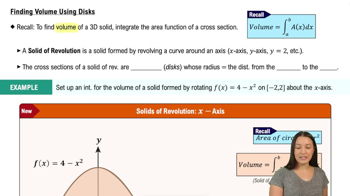
 04:48
04:48
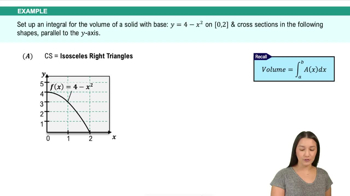 06:18
06:18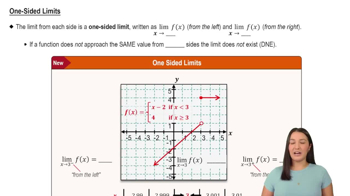 05:50
05:50Assume f is a nonnegative function with a continuous first derivative on [a, b]. The curve y=f(x) on [a, b] is revolved about the x-axis. Explain how to find the area of the surface that is generated.
52–54. Force on a window A diving pool that is 4 m deep and full of water has a viewing window on one of its vertical walls. Find the force on the following windows.
The window is circular, with a radius of 0.5 m, tangent to the bottom of the pool.
Find the area of the region described in the following exercises.
The region in the first quadrant bounded by y=x^2/3 and y=4
Assume f and g are continuous, with f(x) ≥ g(x) ≥ 0 on [a, b]. The region bounded by the graphs of f and g and the lines x=a and x=b is revolved about the y-axis. Write the integral given by the shell method that equals the volume of the resulting solid.
Let R be the region bounded by the following curves. Find the volume of the solid generated when R is revolved about the given line.
x=2−secy,x=2,y=π/3, and y=0; about x=2
13–20. Mass of one-dimensional objects Find the mass of the following thin bars with the given density function.
ρ(x) = {1 if 0≤x≤2 {2 if 2<x≤3