
Ch. 6 - Applications of Integration
Briggs - Calculus: Early Transcendentals 3rd Edition
Briggs3rd EditionCalculus: Early TranscendentalsISBN: 9780136847243Not the one you use?Change textbook
Chapter 6, Problem 6.7.42b

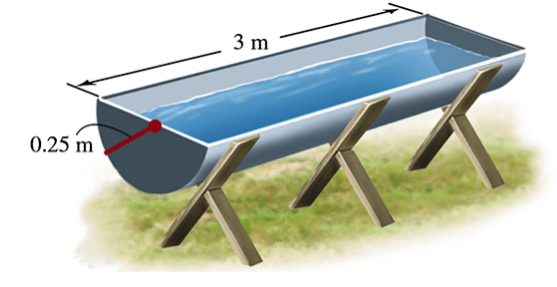
Emptying a water trough A water trough has a semicircular cross section with a radius of 0.25 m and a length of 3 m (see figure).
b. If the length is doubled, is the required work doubled? Explain.

Verified step by step guidance
1
Step 1: Understand the problem context. The trough has a semicircular cross section with radius 0.25 m and length 3 m. The work required to empty the trough depends on the volume of water and the distance it must be lifted.
Step 2: Recall that work is calculated as the integral of force times distance. Here, force is related to the weight of the water, which depends on the volume of water and the density of water.
Step 3: The volume of water in the trough is the area of the semicircular cross section multiplied by the length. The area of a semicircle is given by \(\frac{1}{2} \pi r^2\), so the volume is \(V = \frac{1}{2} \pi (0.25)^2 \times 3\).
Step 4: If the length is doubled, the volume of water doubles because the cross-sectional area remains the same but the length doubles. Therefore, the total weight of the water doubles.
Step 5: Since the work is the integral of weight times the distance the water is lifted, and the lifting distance does not change with length, doubling the length doubles the volume and weight, thus doubling the required work.

Verified video answer for a similar problem:

This video solution was recommended by our tutors as helpful for the problem above.
Video duration:
4m
Was this helpful?

Key Concepts

Here are the essential concepts you must grasp in order to answer the question correctly.

Work Done by a Variable Force

Work is the integral of force over distance. When emptying a trough, the force varies with the depth of water, so the work is calculated by integrating the weight of water lifted at each depth multiplied by the distance it is lifted.
Recommended video:
05:40
Work Done On A Spring (Hooke's Law)

Volume and Cross-Sectional Area

The volume of water in the trough depends on the cross-sectional area and the length. Doubling the length doubles the volume, which directly affects the total weight and thus the work required to empty the trough.
Recommended video:
05:38
Introduction to Cross Sections

Linear Scaling of Work with Length

Since the cross-sectional shape and height remain constant, the work required to empty the trough scales linearly with its length. Doubling the length doubles the volume and weight of water, so the total work required is also doubled.
Recommended video:
06:22
Introduction To Work
Related Practice
Textbook Question

For the given regions R₁ and R₂, complete the following steps.


b. Find the area of region R₂ using geometry and the answer to part (a).


R₁is the region in the first quadrant bounded by the line x=1 and the curve y=6x(2−x^2)^2; R₂ is the region in the first quadrant bounded the curve y=6x(2−x^2)^2and the line y=6x.

Textbook Question

Variable gravity At Earth’s surface, the acceleration due to gravity is approximately g=9.8 m/s² (with local variations). However, the acceleration decreases with distance from the surface according to Newton’s law of gravitation. At a distance of y meters from Earth’s surface, the acceleration is given by a(y) = - g / (1+y/R)², where R=6.4×10⁶ m is the radius of Earth.


b. Use the Chain Rule to show that dv/dt = 1/2 d/dy(v²).

Textbook Question

Displacement and distance from velocity Consider the velocity function shown below of an object moving along a line. Assume time is measured in seconds and distance is measured in meters. The areas of four regions bounded by the velocity curve and the t-axis are also given.

b. What is the displacement of the object over the interval [2, 6]? 

Textbook Question

Volumes without calculus Solve the following problems with and without calculus. A good picture helps.


b. A cube is inscribed in a right circular cone with a radius of 1 and a height of 3. What is the volume of the cube?

1
views
Textbook Question

Displacement and distance from velocity Consider the graph shown in the figure, which gives the velocity of an object moving along a line. Assume time is measured in hours and distance is measured in miles. The areas of three regions bounded by the velocity curve and the t-axis are also given.

b. What is the displacement of the object over the interval [0,3]?

Textbook Question

55–58. Marginal cost Consider the following marginal cost functions.


b. Find the additional cost incurred in dollars when production is increased from 500 units to 550 units.


C′(x) = 300+10x−0.01x²