Ch. 6 - Applications of Integration
Briggs - Calculus: Early Transcendentals 3rd Edition
Briggs3rd EditionCalculus: Early TranscendentalsISBN: 9780136847243Not the one you use?Change textbook
Chapter 6, Problem 6.1.68b

Variable gravity At Earth’s surface, the acceleration due to gravity is approximately g=9.8 m/s² (with local variations). However, the acceleration decreases with distance from the surface according to Newton’s law of gravitation. At a distance of y meters from Earth’s surface, the acceleration is given by a(y) = - g / (1+y/R)², where R=6.4×10⁶ m is the radius of Earth.


b. Use the Chain Rule to show that dv/dt = 1/2 d/dy(v²).

Verified step by step guidance
1
Recall that velocity \(v\) is a function of time \(t\), and position \(y\) is also a function of time \(t\). Therefore, \(v = \frac{dy}{dt}\) and \(v\) can be considered as \(v(y(t))\).
Start with the expression \(\frac{d}{dt}(v^2)\). Using the Chain Rule, this derivative can be written as \(\frac{d}{dt}(v^2) = \frac{d}{dy}(v^2) \cdot \frac{dy}{dt}\).
Since \(\frac{dy}{dt} = v\), substitute this into the expression to get \(\frac{d}{dt}(v^2) = \frac{d}{dy}(v^2) \cdot v\).
Now, solve for \(\frac{dv}{dt}\) by differentiating \(v^2 = (v)^2\) with respect to \(t\): \(\frac{d}{dt}(v^2) = 2v \frac{dv}{dt}\).
Equate the two expressions for \(\frac{d}{dt}(v^2)\): \(2v \frac{dv}{dt} = \frac{d}{dy}(v^2) \cdot v\). Divide both sides by \$2v$ (assuming \(v \neq 0\)) to isolate \(\frac{dv}{dt}\), yielding \(\frac{dv}{dt} = \frac{1}{2} \frac{d}{dy}(v^2)\).

Verified video answer for a similar problem:

This video solution was recommended by our tutors as helpful for the problem above.
Video duration:
3m
Was this helpful?

Key Concepts

Here are the essential concepts you must grasp in order to answer the question correctly.

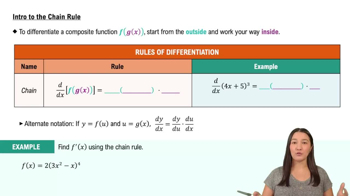
Chain Rule

The Chain Rule is a fundamental differentiation technique used to compute the derivative of a composite function. It states that if a variable depends on an intermediate variable, which in turn depends on another variable, the derivative is the product of the derivatives along the chain. In this problem, it helps relate derivatives with respect to time and position.
Recommended video:
05:02
Intro to the Chain Rule

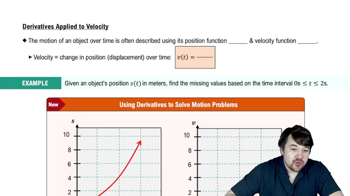
Relationship Between Velocity and Position

Velocity (v) is the rate of change of position (y) with respect to time (t), expressed as v = dy/dt. This relationship allows us to connect derivatives with respect to time and position, which is essential when applying the Chain Rule to rewrite dv/dt in terms of derivatives with respect to y.
Recommended video:
06:29
Derivatives Applied To Velocity

Derivative of a Function Squared

When differentiating the square of a function, such as v², the power rule combined with the Chain Rule applies: d/dy(v²) = 2v dv/dy. Recognizing this helps transform expressions involving dv/dt into forms involving d/dy(v²), facilitating the proof requested in the question.
Recommended video:
06:30
Derivatives of Other Trig Functions
Related Practice
Textbook Question

Displacement and distance from velocity Consider the velocity function shown below of an object moving along a line. Assume time is measured in seconds and distance is measured in meters. The areas of four regions bounded by the velocity curve and the t-axis are also given.

b. What is the displacement of the object over the interval [2, 6]? 

Textbook Question

Power and energy The terms power and energy are often used interchangeably, but they are quite different. Energy is what makes matter move or heat up and is measured in units of joules (J) or Calories (Cal), where 1 Cal=4184 J. One hour of walking consumes roughly 10⁶ J, or 250 Cal. On the other hand, power is the rate at which energy is used and is measured in watts (W; 1W=1 J/s). Other useful units of power are kilowatts (1 kW=10³ W) and megawatts (1 MW=10⁶ W). If energy is used at a rate of 1 kW for 1 hr, the total amount of energy used is 1 kilowatt-hour (kWh), which is 3.6×10⁶ J. Suppose the power function of a large city over a 24-hr period is given by P(t) = E'(t) = 300 - 200 sin πt/12, where P is measured in megawatts and t=0 corresponds to 6:00 P.M. (see figure).


b. Burning 1 kg of coal produces about 450 kWh of energy. How many kilograms of coal are required to meet the energy needs of the city for 1 day? For 1 year? 

Textbook Question

Emptying a water trough A water trough has a semicircular cross section with a radius of 0.25 m and a length of 3 m (see figure).

b. If the length is doubled, is the required work doubled? Explain.

1
views
Textbook Question

Displacement and distance from velocity Consider the graph shown in the figure, which gives the velocity of an object moving along a line. Assume time is measured in hours and distance is measured in miles. The areas of three regions bounded by the velocity curve and the t-axis are also given.

b. What is the displacement of the object over the interval [0,3]?

Textbook Question

21–30. {Use of Tech} Arc length by calculator


b. If necessary, use technology to evaluate or approximate the integral.

y = cos 2x, for 0 ≤ x ≤ π

Textbook Question

Cycling distance A cyclist rides down a long straight road with a velocity (in m/min) given by v(t) = 400−20t, for 0≤t≤10, where t is measured in minutes.


b. How far does the cyclist travel in the first 10 min?