Ch. 6 - Applications of Integration
Briggs - Calculus: Early Transcendentals 3rd Edition
Briggs3rd EditionCalculus: Early TranscendentalsISBN: 9780136847243Not the one you use?Change textbook
Chapter 6, Problem 6.1.8b

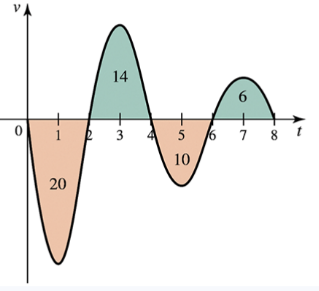
Displacement and distance from velocity Consider the velocity function shown below of an object moving along a line. Assume time is measured in seconds and distance is measured in meters. The areas of four regions bounded by the velocity curve and the t-axis are also given.

b. What is the displacement of the object over the interval [2, 6]? 

Verified step by step guidance
1
Identify the interval over which you need to find the displacement, which is from \(t=2\) to \(t=6\) seconds.
Recall that displacement over a time interval is the net change in position, which can be found by integrating the velocity function over that interval: \(\text{Displacement} = \int_{2}^{6} v(t) \, dt\).
Use the given areas under the velocity curve between \(t=2\) and \(t=6\). From the graph, the velocity is positive from \(t=2\) to \(t=4\) with an area of 14, and negative from \(t=4\) to \(t=6\) with an area of 10.
Since the velocity is positive on \([2,4]\), the displacement contribution is +14 meters, and since the velocity is negative on \([4,6]\), the displacement contribution is -10 meters.
Add these signed areas to find the total displacement over \([2,6]\): \(14 + (-10) = 14 - 10\) meters.

Verified video answer for a similar problem:

This video solution was recommended by our tutors as helpful for the problem above.
Video duration:
2m
Was this helpful?

Key Concepts

Here are the essential concepts you must grasp in order to answer the question correctly.

Velocity and Displacement

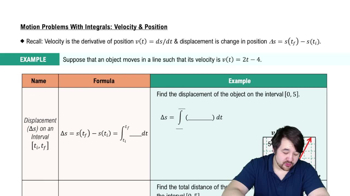
Velocity is the rate of change of position with respect to time and can be positive or negative depending on direction. Displacement over a time interval is the net change in position, calculated as the integral of velocity over that interval, which corresponds to the signed area under the velocity curve.
Recommended video:
10:17
Using The Velocity Function

Definite Integral as Area Under a Curve

The definite integral of a function over an interval represents the net area between the function's graph and the horizontal axis. For velocity, positive areas indicate movement in one direction, while negative areas indicate movement in the opposite direction, affecting the total displacement.
Recommended video:
05:43
Definition of the Definite Integral

Interpreting Signed Areas for Displacement

When calculating displacement from velocity, areas above the time-axis contribute positively, and areas below contribute negatively. Summing these signed areas over the interval gives the object's net displacement, reflecting both magnitude and direction of movement.
Recommended video:
05:06
Finding Area When Bounds Are Not Given
Related Practice
Textbook Question

Variable gravity At Earth’s surface, the acceleration due to gravity is approximately g=9.8 m/s² (with local variations). However, the acceleration decreases with distance from the surface according to Newton’s law of gravitation. At a distance of y meters from Earth’s surface, the acceleration is given by a(y) = - g / (1+y/R)², where R=6.4×10⁶ m is the radius of Earth.


b. Use the Chain Rule to show that dv/dt = 1/2 d/dy(v²).

Textbook Question

Power and energy The terms power and energy are often used interchangeably, but they are quite different. Energy is what makes matter move or heat up and is measured in units of joules (J) or Calories (Cal), where 1 Cal=4184 J. One hour of walking consumes roughly 10⁶ J, or 250 Cal. On the other hand, power is the rate at which energy is used and is measured in watts (W; 1W=1 J/s). Other useful units of power are kilowatts (1 kW=10³ W) and megawatts (1 MW=10⁶ W). If energy is used at a rate of 1 kW for 1 hr, the total amount of energy used is 1 kilowatt-hour (kWh), which is 3.6×10⁶ J. Suppose the power function of a large city over a 24-hr period is given by P(t) = E'(t) = 300 - 200 sin πt/12, where P is measured in megawatts and t=0 corresponds to 6:00 P.M. (see figure).


b. Burning 1 kg of coal produces about 450 kWh of energy. How many kilograms of coal are required to meet the energy needs of the city for 1 day? For 1 year? 

Textbook Question

Volumes without calculus Solve the following problems with and without calculus. A good picture helps.


b. A cube is inscribed in a right circular cone with a radius of 1 and a height of 3. What is the volume of the cube?

1
views
Textbook Question

Emptying a water trough A water trough has a semicircular cross section with a radius of 0.25 m and a length of 3 m (see figure).

b. If the length is doubled, is the required work doubled? Explain.

1
views
Textbook Question

Displacement and distance from velocity Consider the graph shown in the figure, which gives the velocity of an object moving along a line. Assume time is measured in hours and distance is measured in miles. The areas of three regions bounded by the velocity curve and the t-axis are also given.

b. What is the displacement of the object over the interval [0,3]?

Textbook Question

55–58. Marginal cost Consider the following marginal cost functions.


b. Find the additional cost incurred in dollars when production is increased from 500 units to 550 units.


C′(x) = 300+10x−0.01x²