
Ch. 6 - Applications of Integration
Briggs - Calculus: Early Transcendentals 3rd Edition
Briggs3rd EditionCalculus: Early TranscendentalsISBN: 9780136847243Not the one you use?Change textbook
Chapter 6, Problem 6.2.35b

For the given regions R₁ and R₂, complete the following steps.


b. Find the area of region R₂ using geometry and the answer to part (a).


R₁is the region in the first quadrant bounded by the line x=1 and the curve y=6x(2−x^2)^2; R₂ is the region in the first quadrant bounded the curve y=6x(2−x^2)^2and the line y=6x.

Verified step by step guidance
1
First, clearly identify the boundaries of region R₂. It is bounded above and below by the curves \( y = 6x(2 - x^2)^2 \) and \( y = 6x \), respectively, in the first quadrant. Determine the interval of \( x \) over which these two curves intersect to define the horizontal limits of R₂.
Find the points of intersection between the two curves by setting \( 6x(2 - x^2)^2 = 6x \). Since \( 6x \) is common on both sides, consider the cases where \( x = 0 \) or \( (2 - x^2)^2 = 1 \). Solve for \( x \) to find the exact intersection points that bound R₂.
Use the result from part (a), which likely gives the area of region R₁ bounded by \( x = 1 \) and \( y = 6x(2 - x^2)^2 \), to help express the area of R₂. Since R₂ lies between the two curves, the area of R₂ can be found by subtracting the area under \( y = 6x \) from the area under \( y = 6x(2 - x^2)^2 \) over the interval determined in step 2.
Set up the integral expression for the area of R₂ as \( \int_{a}^{b} \left[6x(2 - x^2)^2 - 6x\right] \, dx \), where \( a \) and \( b \) are the intersection points found earlier. This integral represents the vertical distance between the two curves integrated over the interval where R₂ exists.
Evaluate the integral expression or use the known area from part (a) to compute the area of R₂. Remember, the integral of \( 6x \) over the interval can be subtracted from the integral of \( 6x(2 - x^2)^2 \) to find the exact area of R₂.

Verified video answer for a similar problem:

This video solution was recommended by our tutors as helpful for the problem above.
Video duration:
5m
Was this helpful?

Key Concepts

Here are the essential concepts you must grasp in order to answer the question correctly.

Area of a Region Bounded by Curves

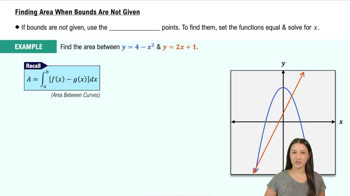
Finding the area between curves involves integrating the difference of the functions that bound the region. When the region is bounded by a curve and a line, the area can be computed by integrating the vertical distance between them over the interval where they intersect.
Recommended video:
05:06
Finding Area When Bounds Are Not Given

Using Geometry to Find Areas

Some regions can be decomposed into or approximated by basic geometric shapes like rectangles, triangles, or trapezoids. Using geometric formulas for these shapes can simplify area calculations, especially when combined with known areas from previous parts of the problem.
Recommended video:
05:06
Finding Area When Bounds Are Not Given

Interpreting and Using Given Functions and Boundaries

Understanding the given curves and lines, including their intersections and behavior in the first quadrant, is essential. This involves analyzing the functions y=6x(2−x²)² and y=6x, determining their points of intersection, and correctly identifying the regions R₁ and R₂ for area calculations.
Recommended video:
05:59
Determining Concavity Given a Function