
Ch. 6 - Applications of Integration
Briggs - Calculus: Early Transcendentals 3rd Edition
Briggs3rd EditionCalculus: Early TranscendentalsISBN: 9780136847243Not the one you use?Change textbook
Chapter 6, Problem 6.4.8b

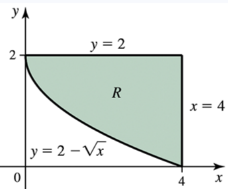
6–8. Let R be the region bounded by the curves y = 2−√x,y=2, and x=4 in the first quadrant.
Graph showing region R bounded by curves y=2, y=2−√x, and line x=4 in the first quadrant.
Suppose the shell method is used to determine the volume of the solid generated by revolving R about the line x=4.


b. What is the height of a cylindrical shell at a point x in [0, 4]?

Verified step by step guidance
1
Step 1: Understand the problem. The region R is bounded by the curves y = 2−√x, y = 2, and x = 4 in the first quadrant. We are tasked with finding the height of a cylindrical shell at a point x in [0, 4] when the region is revolved about the line x = 4 using the shell method.
Step 2: Recall the shell method formula. The height of a cylindrical shell is determined by the vertical distance between the top curve and the bottom curve at a given x-coordinate. In this case, the top curve is y = 2 and the bottom curve is y = 2−√x.
Step 3: Calculate the height of the shell. The height is given by the difference between the top curve and the bottom curve: height = y_top − y_bottom. Substituting the equations, height = 2 − (2−√x).
Step 4: Simplify the expression for the height. Perform the subtraction: height = 2 − 2 + √x, which simplifies to height = √x.
Step 5: Conclude that the height of the cylindrical shell at a point x in [0, 4] is √x. This height will be used in the shell method formula to compute the volume of the solid.

Verified video answer for a similar problem:

This video solution was recommended by our tutors as helpful for the problem above.
Video duration:
1m
Was this helpful?

Key Concepts

Here are the essential concepts you must grasp in order to answer the question correctly.

Cylindrical Shell Method

The cylindrical shell method is a technique for finding the volume of a solid of revolution. It involves slicing the solid into thin cylindrical shells, which are then integrated to find the total volume. When revolving around a vertical line, the height of each shell is determined by the function defining the region, and the radius is the distance from the axis of rotation.
Recommended video:
07:33
Euler's Method

Height of a Shell

In the context of the shell method, the height of a cylindrical shell at a point x is given by the difference between the upper and lower bounding functions of the region being revolved. For the given region R, the height is calculated as the vertical distance between the line y = 2 and the curve y = 2 - √x, specifically expressed as h(x) = 2 - (2 - √x) = √x.
Recommended video:
06:51
Derivatives Applied To Acceleration Example 2

Bounded Region

A bounded region in calculus refers to a specific area enclosed by curves or lines on a graph. In this case, region R is bounded by the curves y = 2, y = 2 - √x, and the vertical line x = 4. Understanding the boundaries is crucial for accurately applying integration techniques to find volumes or areas related to the region.
Recommended video:
07:45
Area of Polar Regions
Related Practice
Textbook Question

For the given regions R₁ and R₂, complete the following steps.


b. Find the area of region R₂ using geometry and the answer to part (a).


R₁is the region in the first quadrant bounded by the line x=1 and the curve y=6x(2−x^2)^2; R₂ is the region in the first quadrant bounded the curve y=6x(2−x^2)^2and the line y=6x.

Textbook Question

Explain why or why not Determine whether the following statements are true and give an explanation or counterexample.


b. If a region is revolved about the y-axis, then the shell method must be used.

1
views
Textbook Question

13–16. Displacement from velocity Consider an object moving along a line with the given velocity v. Assume time t is measured in seconds and velocities have units of m/s.


b. Find the displacement over the given interval. 


v(t) = 3t²−6t on [0, 3]

Textbook Question

Volumes without calculus Solve the following problems with and without calculus. A good picture helps.


b. A cube is inscribed in a right circular cone with a radius of 1 and a height of 3. What is the volume of the cube?

1
views
Textbook Question

55–58. Marginal cost Consider the following marginal cost functions.


b. Find the additional cost incurred in dollars when production is increased from 500 units to 550 units.


C′(x) = 300+10x−0.01x²

Textbook Question

Oscillating growth rates Some species have growth rates that oscillate with an (approximately) constant period P. Consider the growth rate function N'(t) = r+A sin 2πt/P, where A and r are constants with units of individuals/yr, and t is measured in years. A species becomes extinct if its population ever reaches 0 after t=0.


b. Suppose P=10, A=20, and r=0. If the initial population is N(0)=100, does the population ever become extinct? Explain.