
Ch. 6 - Applications of Integration
Briggs - Calculus: Early Transcendentals 3rd Edition
Briggs3rd EditionCalculus: Early TranscendentalsISBN: 9780136847243Not the one you use?Change textbook
Chapter 6, Problem 6.1.52b

Oscillating growth rates Some species have growth rates that oscillate with an (approximately) constant period P. Consider the growth rate function N'(t) = r+A sin 2πt/P, where A and r are constants with units of individuals/yr, and t is measured in years. A species becomes extinct if its population ever reaches 0 after t=0.


b. Suppose P=10, A=20, and r=0. If the initial population is N(0)=100, does the population ever become extinct? Explain.

Verified step by step guidance
1
Start by writing down the given growth rate function: \(N'(t) = r + A \sin\left(\frac{2\pi t}{P}\right)\), with \(P=10\), \(A=20\), and \(r=0\). So, \(N'(t) = 20 \sin\left(\frac{2\pi t}{10}\right)\).
Recall that the population function \(N(t)\) is the integral of the growth rate \(N'(t)\) with respect to time \(t\). Use the initial condition \(N(0) = 100\) to find the constant of integration after integrating.
Integrate \(N'(t)\): \(N(t) = \int 20 \sin\left(\frac{2\pi t}{10}\right) dt + C\). Use the substitution \(u = \frac{2\pi t}{10}\) to simplify the integral.
After integrating, express \(N(t)\) explicitly in terms of \(t\) and the constant \(C\). Then apply the initial condition \(N(0) = 100\) to solve for \(C\).
Analyze the expression for \(N(t)\) to determine if it ever reaches zero for \(t > 0\). Consider the amplitude and average value of the oscillations to conclude whether extinction (population reaching zero) occurs.

Verified video answer for a similar problem:

This video solution was recommended by our tutors as helpful for the problem above.
Video duration:
4m
Was this helpful?

Key Concepts

Here are the essential concepts you must grasp in order to answer the question correctly.

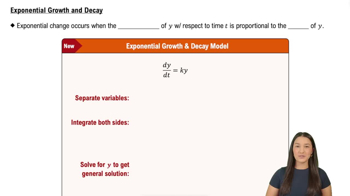
Differential Equations and Population Growth

A differential equation relates a function to its derivative, describing how a quantity changes over time. Here, N'(t) represents the growth rate of the population N(t). Solving or analyzing this equation helps determine the population's behavior, such as whether it reaches zero (extinction).
Recommended video:
09:29
Exponential Growth & Decay

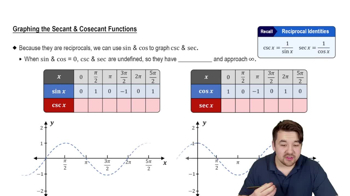
Oscillatory Functions and Periodicity

The growth rate includes a sinusoidal term A sin(2πt/P), which oscillates with period P. This means the growth rate fluctuates regularly over time, causing the population to increase and decrease in cycles. Understanding how these oscillations affect overall growth is key to predicting extinction.
Recommended video:
6:22
Graphs of Secant and Cosecant Functions

Extinction Condition and Population Thresholds

Extinction occurs if the population N(t) reaches zero at any time after t=0. Analyzing whether the integral of the growth rate ever reduces N(t) to zero involves checking if negative growth phases outweigh positive growth, considering initial population and oscillations.
Recommended video:
03:55
The Quotient Rule Example 5
Related Practice
Textbook Question

6–8. Let R be the region bounded by the curves y = 2−√x,y=2, and x=4 in the first quadrant.

Suppose the shell method is used to determine the volume of the solid generated by revolving R about the line x=4.


b. What is the height of a cylindrical shell at a point x in [0, 4]?

Textbook Question

55–58. Marginal cost Consider the following marginal cost functions.


b. Find the additional cost incurred in dollars when production is increased from 500 units to 550 units.


C′(x)=200−0.05x

Textbook Question

Explain why or why not Determine whether the following statements are true and give an explanation or counterexample.


b. If a region is revolved about the y-axis, then the shell method must be used.

1
views
Textbook Question

13–16. Displacement from velocity Consider an object moving along a line with the given velocity v. Assume time t is measured in seconds and velocities have units of m/s.


b. Find the displacement over the given interval. 


v(t) = 3t²−6t on [0, 3]

Textbook Question

40–43. Population growth


When records were first kept (t=0), the population of a rural town was 250 people. During the following years, the population grew at a rate of P′(t) = 30(1+√t), where t is measured in years.


b. Find the population P(t) at any time t≥0.

Textbook Question

Blood flow A typical human heart pumps 70 mL of blood (the stroke volume) with each beat. Assuming a heart rate of 60 beats/min (1 beat/s), a reasonable model for the outflow rate of the heart is V′(t)=70(1+sin 2πt), where V(t) is the amount of blood (in milliliters) pumped over the interval [0,t],V(0)=0 and t is measured in seconds.


b. Find the function that gives the total blood pumped between t=0 and a future time t>0.