
Ch. 3 - Derivatives
Briggs - Calculus: Early Transcendentals 3rd Edition
Briggs3rd EditionCalculus: Early TranscendentalsISBN: 9780136847243Not the one you use?Change textbook
Chapter 3, Problem 3.6.58d

{Use of Tech} Flow from a tank A cylindrical tank is full at time t=0 when a valve in the bottom of the tank is opened. By Torricelli’s law, the volume of water in the tank after t hours is V=100(200−t)², measured in cubic meters.
d. At what time is the magnitude of the flow rate a minimum? A maximum?  

Verified step by step guidance
1
First, understand that the flow rate is the derivative of the volume with respect to time. So, we need to find the derivative of V with respect to t, which is V(t) = 100(200-t)^2.
Apply the chain rule to differentiate V(t) = 100(200-t)^2. Let u = 200-t, then V(t) = 100u^2. The derivative of V with respect to t is dV/dt = 100 * 2u * (-1) = -200u.
Substitute back u = 200-t into the derivative to get dV/dt = -200(200-t). This represents the flow rate of water from the tank.
To find when the flow rate is a minimum or maximum, we need to analyze the critical points of dV/dt. Set the derivative of dV/dt with respect to t equal to zero and solve for t.
Since dV/dt = -200(200-t), the derivative is constant and does not have any critical points. Therefore, the flow rate is maximum at t=0 and decreases linearly over time, reaching a minimum when the tank is empty.

Verified video answer for a similar problem:

This video solution was recommended by our tutors as helpful for the problem above.
Video duration:
2m
Was this helpful?

Key Concepts

Here are the essential concepts you must grasp in order to answer the question correctly.

Torricelli's Law

Torricelli's Law describes the speed of fluid flowing out of an orifice under the influence of gravity. It states that the speed of efflux is proportional to the square root of the height of the fluid above the opening. This principle is crucial for understanding how the volume of water in the tank changes over time, as it directly relates to the flow rate and the volume function provided.

Flow Rate

The flow rate is the volume of fluid that passes through a given surface per unit time. In this context, it can be determined by taking the derivative of the volume function V(t) with respect to time t. Analyzing the flow rate helps identify when it reaches its minimum and maximum values, which is essential for solving the problem posed.
Recommended video:
04:16
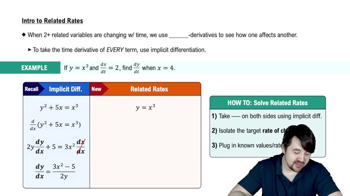
Intro To Related Rates

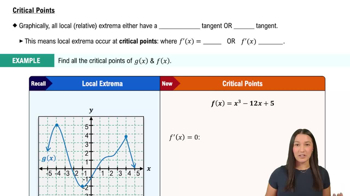
Critical Points

Critical points occur where the derivative of a function is zero or undefined, indicating potential local maxima or minima. To find the times when the flow rate is at a minimum or maximum, one must calculate the derivative of the flow rate function and solve for these critical points. This analysis is fundamental in determining the behavior of the flow rate over time.
Recommended video:
04:50
Critical Points