Ch. 3 - Derivatives
Briggs - Calculus: Early Transcendentals 3rd Edition
Briggs3rd EditionCalculus: Early TranscendentalsISBN: 9780136847243Not the one you use?Change textbook
Chapter 3, Problem 3.10.7d

Derivatives of inverse functions from a table Use the following tables to determine the indicated derivatives or state that the derivative cannot be determined. <IMAGE>
d. f'(1)

Verified step by step guidance
1
First, understand that the problem involves finding the derivative of an inverse function. If f(x) and g(x) are inverse functions, then g'(x) = 1 / f'(g(x)).
Identify the inverse relationship from the table. If f(x) and g(x) are inverses, then f(g(x)) = x and g(f(x)) = x.
Locate the value of g(1) from the table, which will give you the corresponding x value for f(x) such that f(x) = 1.
Once you have g(1), use the formula for the derivative of an inverse function: g'(x) = 1 / f'(g(x)).
Substitute g(1) into the formula to find f'(1) using the relationship f'(g(1)) = 1 / g'(1). Check the table for g'(1) if available.

Verified video answer for a similar problem:

This video solution was recommended by our tutors as helpful for the problem above.
Video duration:
1m
Was this helpful?

Key Concepts

Here are the essential concepts you must grasp in order to answer the question correctly.

Inverse Functions

Inverse functions are functions that reverse the effect of the original function. If a function f takes an input x and produces an output y, then its inverse f⁻¹ takes y back to x. Understanding how to find and work with inverse functions is crucial for determining derivatives of these functions.
Recommended video:
4:49
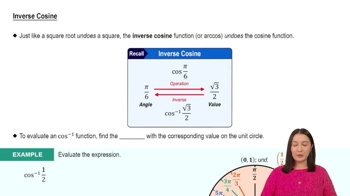
Inverse Cosine

Derivative of Inverse Functions

The derivative of an inverse function can be found using the formula (f⁻¹)'(y) = 1 / f'(x), where y = f(x). This relationship shows that the derivative of the inverse at a point is the reciprocal of the derivative of the original function at the corresponding point. This concept is essential for solving problems involving derivatives of inverse functions.
Recommended video:
07:26
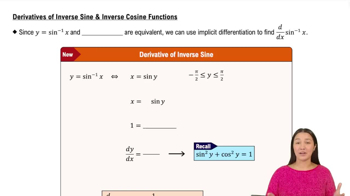
Derivatives of Inverse Sine & Inverse Cosine

Using Tables for Derivatives

When working with derivatives from a table, it is important to locate the relevant values for the function and its inverse. The table typically provides values of the function and its derivative at specific points, which can be used to find the derivative of the inverse function. If the necessary values are not present, it may be impossible to determine the derivative.
Recommended video:
05:44
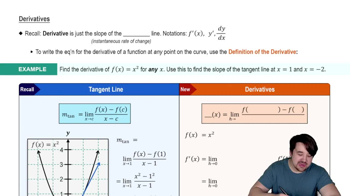
Derivatives
Related Practice
Textbook Question

Witch of Agnesi Let y(x²+4)=8 (see figure). <IMAGE>

d. Verify that the results of parts (a) and (c) are consistent.

Textbook Question

97–100. Logistic growth Scientists often use the logistic growth function P(t) = P₀K / P₀+(K−P₀)e^−r₀t to model population growth, where P₀ is the initial population at time t=0, K is the carrying capacity, and r₀ is the base growth rate. The carrying capacity is a theoretical upper bound on the total population that the surrounding environment can support. The figure shows the sigmoid (S-shaped) curve associated with a typical logistic model. <IMAGE>


{Use of Tech} Gone fishing When a reservoir is created by a new dam, 50 fish are introduced into the reservoir, which has an estimated carrying capacity of 8000 fish. A logistic model of the fish population is P(t) = 400,000 / 50+7950e^−0.5t, where t is measured in years.


d. Graph P' and use the graph to estimate the year in which the population is growing fastest. 

Textbook Question

Airline travel The following figure shows the position function of an airliner on an out-and-back trip from Seattle to Minneapolis, where s = f(t) is the number of ground miles from Seattle t hours after take-off at 6:00 A.M. The plane returns to Seattle 8.5 hours later at 2:30 P.M. <IMAGE>

d. Determine the velocity of the airliner at noon (t = 6) and explain why the velocity is negative.

Textbook Question

{Use of Tech} Flow from a tank A cylindrical tank is full at time t=0 when a valve in the bottom of the tank is opened. By Torricelli’s law, the volume of water in the tank after t hours is V=100(200−t)², measured in cubic meters.

d. At what time is the magnitude of the flow rate a minimum? A maximum?  

Textbook Question

Explain why or why not Determine whether the following statements are true and give an explanation or counterexample.

d. The lines tangent to the graph of y=sin x on the interval [−π/2,π/2] have a maximum slope of 1.

Textbook Question

Derivatives using tables Let h(x)=f(g(x))h(x)=f(g(x)) and p(x)=g(f(x))p(x)=g(f(x)). Use the table to compute the following derivatives.

<IMAGE>

d. p(2)p^{\(\prime\)}\(\left\)(2\(\right\))

2
views