
Ch. 3 - Derivatives
Briggs - Calculus: Early Transcendentals 3rd Edition
Briggs3rd EditionCalculus: Early TranscendentalsISBN: 9780136847243Not the one you use?Change textbook
Chapter 3, Problem 3.85c

Finding derivatives from a table Find the values of the following derivatives using the table. <IMAGE>


c. d/dx ((f(x)g(x)) |x=3

Verified step by step guidance
1
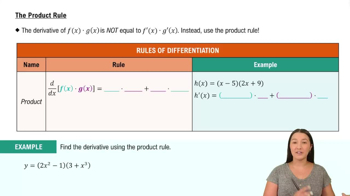
Step 1: Recall the product rule for derivatives, which states that if you have two functions f(x) and g(x), the derivative of their product is given by (f(x)g(x))' = f'(x)g(x) + f(x)g'(x).
Step 2: Identify the values you need from the table. You will need f(3), g(3), f'(3), and g'(3) to apply the product rule at x = 3.
Step 3: Substitute the values from the table into the product rule formula. This means replacing f(x) with f(3), g(x) with g(3), f'(x) with f'(3), and g'(x) with g'(3).
Step 4: Calculate each term separately. First, compute f'(3)g(3) and then f(3)g'(3).
Step 5: Add the results from Step 4 to find the derivative of the product at x = 3.

Verified video answer for a similar problem:

This video solution was recommended by our tutors as helpful for the problem above.
Video duration:
3m
Was this helpful?

Key Concepts

Here are the essential concepts you must grasp in order to answer the question correctly.

Product Rule

The Product Rule is a fundamental differentiation rule used to find the derivative of the product of two functions. It states that if you have two functions, f(x) and g(x), the derivative of their product is given by d/dx(f(x)g(x)) = f'(x)g(x) + f(x)g'(x). This rule is essential for solving problems involving the multiplication of functions.
Recommended video:
05:18
The Product Rule

Evaluating Derivatives at a Point

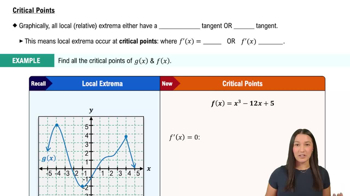
Evaluating derivatives at a specific point involves substituting the value of x into the derivative expression after it has been calculated. In this case, after applying the Product Rule, you will substitute x = 3 into the resulting expression to find the specific value of the derivative at that point. This step is crucial for obtaining numerical answers from derivative expressions.
Recommended video:
04:50
Critical Points

Using Derivative Tables

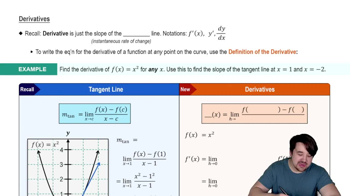
Derivative tables provide pre-calculated values of derivatives for various functions at specific points. When solving derivative problems, such as the one presented, these tables can be used to quickly find f'(3) and g'(3) without needing to compute the derivatives from scratch. This efficiency is particularly useful in problems where time or complexity is a factor.
Recommended video:
05:44
Derivatives
Related Practice
Textbook Question

Tangents and inverses Suppose L(x)=ax+b (with a≠0) is the equation of the line tangent to the graph of a one-to-one function f at (x0,y0). Also, suppose M(x)=cx+d is the equation of the line tangent to the graph of f^−1 at (y0,x0).


c. Prove that L^−1(x)=M(x).

Textbook Question

62–65. {Use of Tech} Graphing f and f'

c. Verify that the zeros of f' correspond to points at which f has a horizontal tangent line.

f(x)=(x²−1)sin^−1 x on [−1,1]

Textbook Question

Highway travel A state patrol station is located on a straight north-south freeway. A patrol car leaves the station at 9:00 A.M. heading north with position function s = f(t) that gives its location in miles t hours after 9:00 A.M. (see figure). Assume s is positive when the car is north of the patrol station. <IMAGE>

c. Find the average velocity of the car over the interval [1.75, 2.25]. Estimate the velocity of the car at 11:00 A.M. and determine the direction in which the patrol car is moving.

Textbook Question

62–65. {Use of Tech} Graphing f and f'

c. Verify that the zeros of f' correspond to points at which f has a horizontal tangent line.

f(x)=e^−x tan^−1 x on [0,∞)

Textbook Question

{Use of Tech} Flow from a tank A cylindrical tank is full at time t=0 when a valve in the bottom of the tank is opened. By Torricelli’s law, the volume of water in the tank after t hours is V=100(200−t)², measured in cubic meters.

d. At what time is the magnitude of the flow rate a minimum? A maximum?  

Textbook Question

City urbanization City planners model the size of their city using the function A(t) = - 1/50t² + 2t +20, for 0 ≤ t ≤ 50, where A is measured in square miles and t is the number of years after 2010.

c. Suppose the population density of the city remains constant from year to year at 1000 people mi². Determine the growth rate of the population in 2030.

1
views