Ch. 3 - Derivatives
Briggs - Calculus: Early Transcendentals 3rd Edition
Briggs3rd EditionCalculus: Early TranscendentalsISBN: 9780136847243Not the one you use?Change textbook
Chapter 3, Problem 3.10.63c

62–65. {Use of Tech} Graphing f and f'
c. Verify that the zeros of f' correspond to points at which f has a horizontal tangent line.
f(x)=(x²−1)sin^−1 x on [−1,1]

Verified step by step guidance
1
Step 1: Understand the problem. We need to verify that the zeros of the derivative of the function f(x) = (x^2 - 1)sin^{-1}(x) correspond to points where the original function f(x) has a horizontal tangent line.
Step 2: Find the derivative f'(x). Use the product rule for differentiation, since f(x) is a product of two functions: u(x) = x^2 - 1 and v(x) = sin^{-1}(x). The product rule states that (uv)' = u'v + uv'.
Step 3: Differentiate u(x) and v(x) separately. For u(x) = x^2 - 1, the derivative u'(x) = 2x. For v(x) = sin^{-1}(x), the derivative v'(x) = 1/√(1-x^2).
Step 4: Apply the product rule. Substitute u(x), u'(x), v(x), and v'(x) into the product rule formula to find f'(x) = (x^2 - 1)(1/√(1-x^2)) + (2x)(sin^{-1}(x)).
Step 5: Set f'(x) = 0 to find the zeros of the derivative. Solve the equation (x^2 - 1)(1/√(1-x^2)) + (2x)(sin^{-1}(x)) = 0 to find the x-values where f'(x) is zero. These x-values correspond to points where f(x) has a horizontal tangent line.

Verified video answer for a similar problem:

This video solution was recommended by our tutors as helpful for the problem above.
Video duration:
5m
Was this helpful?

Key Concepts

Here are the essential concepts you must grasp in order to answer the question correctly.

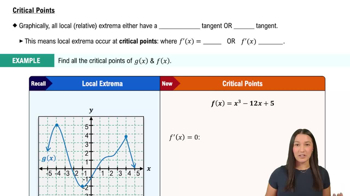
Derivative and Critical Points

The derivative of a function, denoted as f', represents the rate of change of the function f. Critical points occur where the derivative is zero or undefined, indicating potential locations for horizontal tangent lines. In this context, finding the zeros of f' helps identify where the slope of f is zero, which corresponds to horizontal tangents.
Recommended video:
04:50
Critical Points

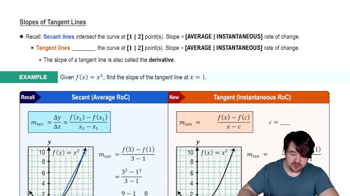
Horizontal Tangent Lines

A horizontal tangent line occurs at points on the graph of a function where the slope is zero. This means that the derivative of the function at those points is equal to zero. Understanding this concept is crucial for verifying the relationship between the zeros of the derivative and the behavior of the original function.
Recommended video:
05:13
Slopes of Tangent Lines

Graphing Functions

Graphing a function involves plotting its values on a coordinate plane to visualize its behavior. By graphing both f(x) and its derivative f'(x), one can observe how the zeros of f' correspond to points where f has horizontal tangents. This visual representation aids in understanding the relationship between a function and its derivative.
Recommended video:
5:53
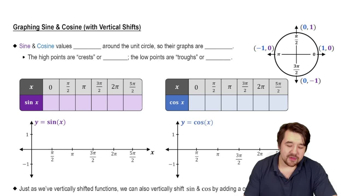
Graph of Sine and Cosine Function
Related Practice
Textbook Question

Tangents and inverses Suppose L(x)=ax+b (with a≠0) is the equation of the line tangent to the graph of a one-to-one function f at (x0,y0). Also, suppose M(x)=cx+d is the equation of the line tangent to the graph of f^−1 at (y0,x0).


c. Prove that L^−1(x)=M(x).

Textbook Question

Airline travel The following figure shows the position function of an airliner on an out-and-back trip from Seattle to Minneapolis, where s = f(t) is the number of ground miles from Seattle t hours after take-off at 6:00 A.M. The plane returns to Seattle 8.5 hours later at 2:30 P.M. <IMAGE>

d. Determine the velocity of the airliner at noon (t = 6) and explain why the velocity is negative.

Textbook Question

Highway travel A state patrol station is located on a straight north-south freeway. A patrol car leaves the station at 9:00 A.M. heading north with position function s = f(t) that gives its location in miles t hours after 9:00 A.M. (see figure). Assume s is positive when the car is north of the patrol station. <IMAGE>

c. Find the average velocity of the car over the interval [1.75, 2.25]. Estimate the velocity of the car at 11:00 A.M. and determine the direction in which the patrol car is moving.

Textbook Question

62–65. {Use of Tech} Graphing f and f'

c. Verify that the zeros of f' correspond to points at which f has a horizontal tangent line.

f(x)=e^−x tan^−1 x on [0,∞)

Textbook Question

{Use of Tech} Flow from a tank A cylindrical tank is full at time t=0 when a valve in the bottom of the tank is opened. By Torricelli’s law, the volume of water in the tank after t hours is V=100(200−t)², measured in cubic meters.

d. At what time is the magnitude of the flow rate a minimum? A maximum?  

Textbook Question

Finding derivatives from a table Find the values of the following derivatives using the table. <IMAGE>


c. d/dx ((f(x)g(x)) |x=3

1
views