Ch. 2 - Limits
Briggs - Calculus: Early Transcendentals 3rd Edition
Briggs3rd EditionCalculus: Early TranscendentalsISBN: 9780136847243Not the one you use?Change textbook
Chapter 2, Problem 2.4.56

Find polynomials p and q such that f=p/q is undefined at 1 and 2, but f has a vertical asymptote only at 2. Sketch a graph of your function.

Verified step by step guidance
1
Step 1: Understand the problem requirements. We need to find polynomials p(x) and q(x) such that the rational function f(x) = \(\frac{p(x)}{q(x)}\) is undefined at x = 1 and x = 2, but has a vertical asymptote only at x = 2.
Step 2: Recall that a rational function is undefined where its denominator is zero. To make f(x) undefined at x = 1 and x = 2, q(x) should have factors (x - 1) and (x - 2).
Step 3: To ensure a vertical asymptote at x = 2, the factor (x - 2) should not be canceled out by the numerator p(x). Therefore, p(x) should not have the factor (x - 2).
Step 4: To make f(x) defined at x = 1, the factor (x - 1) in q(x) should be canceled by a similar factor in p(x). Thus, p(x) should have the factor (x - 1).
Step 5: Construct the polynomials. Let p(x) = (x - 1) and q(x) = (x - 1)(x - 2). This ensures f(x) = \(\frac{(x - 1)}{(x - 1)(x - 2)}\) is undefined at x = 1 and 2, but has a vertical asymptote only at x = 2.

Verified video answer for a similar problem:

This video solution was recommended by our tutors as helpful for the problem above.
Video duration:
5m
Was this helpful?

Key Concepts

Here are the essential concepts you must grasp in order to answer the question correctly.

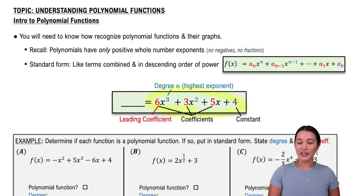
Polynomials

Polynomials are mathematical expressions consisting of variables raised to non-negative integer powers and coefficients. They can be represented in the form p(x) = a_n*x^n + a_(n-1)*x^(n-1) + ... + a_1*x + a_0, where a_n are constants and n is a non-negative integer. Understanding polynomials is crucial for constructing rational functions, as they form the numerator and denominator in the expression f = p/q.
Recommended video:
6:04
Introduction to Polynomial Functions

Vertical Asymptotes

Vertical asymptotes occur in rational functions when the denominator approaches zero while the numerator remains non-zero, leading to the function tending towards infinity. For the function f = p/q to have a vertical asymptote at x = 2, the polynomial q must have a factor (x - 2) that causes q(2) = 0, while p(2) must not equal zero. This concept is essential for determining the behavior of the function near specific points.
Recommended video:
3:40
Introduction to Cotangent Graph Example 1

Undefined Points

A function is undefined at points where its denominator equals zero, as division by zero is not permissible. In the context of the given question, the function f = p/q must be undefined at x = 1 and x = 2, meaning that q must have factors (x - 1) and (x - 2). However, to ensure a vertical asymptote only at x = 2, the factor (x - 1) must be canceled out in the numerator p, which influences the overall behavior of the function.
Recommended video:
04:50
Critical Points