Ch. 2 - Limits
Briggs - Calculus: Early Transcendentals 3rd Edition
Briggs3rd EditionCalculus: Early TranscendentalsISBN: 9780136847243Not the one you use?Change textbook
Chapter 2, Problem 2.5.68

If a function f represents a system that varies in time, the existence of lim limtf(t){\(\displaystyle\[\lim\)_{t\(\rightarrow\]\infty\)}{f(t)}} means that the system reaches a steady state (or equilibrium). For the following systems, determine whether a steady state exists and give the steady-state value.


The population of a colony of squirrels is given by p(t)=15003+2e0.1tp\(\left\)(t\(\right\))=\(\frac{1500}{3+2e^{-0.1t}\)}.

Verified step by step guidance
1
Identify the function that describes the system: p(t) = \(\frac{1500}{3 + 2e^{-0.1t}\)}.
To determine if a steady state exists, evaluate the limit of p(t) as t approaches infinity: \(\lim\)_{t \(\to\) \(\infty\)} p(t).
Observe that as t approaches infinity, the term e^{-0.1t} approaches zero because the exponential function decays to zero.
Substitute e^{-0.1t} with 0 in the expression for p(t) to simplify the limit: \(\lim\)_{t \(\to\) \(\infty\)} \(\frac{1500}{3 + 2 \cdot 0}\).
Calculate the simplified expression to find the steady-state value: \(\frac{1500}{3}\).

Verified video answer for a similar problem:

This video solution was recommended by our tutors as helpful for the problem above.
Video duration:
2m
Was this helpful?

Key Concepts

Here are the essential concepts you must grasp in order to answer the question correctly.

Limit of a Function

The limit of a function describes the behavior of that function as the input approaches a certain value, which can be finite or infinite. In this context, the limit as t approaches infinity indicates how the function behaves as time progresses indefinitely. Understanding limits is crucial for analyzing the long-term behavior of dynamic systems, such as population models.
Recommended video:
06:11
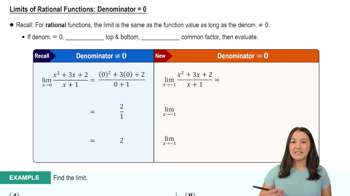
Limits of Rational Functions: Denominator = 0

Steady State (Equilibrium)

A steady state, or equilibrium, occurs when a system's variables no longer change over time, meaning that the system has reached a stable condition. In mathematical terms, this is often represented by the limit of a function as time approaches infinity being a constant value. Identifying steady states is essential in various fields, including biology and economics, to predict long-term outcomes.
Recommended video:
05:40
Work Done On A Spring (Hooke's Law)

Exponential Decay

Exponential decay refers to a process where a quantity decreases at a rate proportional to its current value, often modeled by functions involving the exponential function e. In the given population model, the term e^{-0.1t} represents the decay of the influence of initial conditions over time, which is critical for determining how the population stabilizes as time progresses.
Recommended video:
09:29
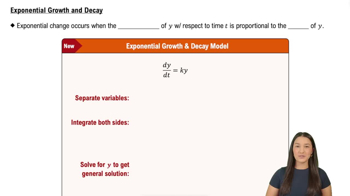
Exponential Growth & Decay