Ch. 2 - Limits
Briggs - Calculus: Early Transcendentals 3rd Edition
Briggs3rd EditionCalculus: Early TranscendentalsISBN: 9780136847243Not the one you use?Change textbook
Chapter 2, Problem 2.4.40

Determine the following limits.


limx0csc(x){\(\displaystyle\[\lim\)_{x\(\to\)0^{-}}}\(\csc\]\left\)(x\(\right\))

Verified step by step guidance
1
Step 1: Understand the function involved. The cosecant function, \( \csc(x) \), is the reciprocal of the sine function, so \( \csc(x) = \frac{1}{\sin(x)} \).
Step 2: Analyze the behavior of \( \sin(x) \) as \( x \to 0^{-} \). As \( x \) approaches 0 from the left, \( \sin(x) \) approaches 0. However, since \( \sin(x) \) is negative just to the left of 0, \( \sin(x) \to 0^{-} \).
Step 3: Consider the reciprocal function \( \csc(x) = \frac{1}{\sin(x)} \). As \( \sin(x) \to 0^{-} \), the value of \( \frac{1}{\sin(x)} \) becomes very large in the negative direction.
Step 4: Conclude the behavior of \( \csc(x) \) as \( x \to 0^{-} \). Since \( \sin(x) \to 0^{-} \), \( \csc(x) \to -\infty \).
Step 5: Summarize the limit. Therefore, \( \lim_{x \to 0^{-}} \csc(x) = -\infty \).

Verified video answer for a similar problem:

This video solution was recommended by our tutors as helpful for the problem above.
Video duration:
4m

Key Concepts

Here are the essential concepts you must grasp in order to answer the question correctly.

Limits

Limits are fundamental concepts in calculus that describe the behavior of a function as its input approaches a certain value. They help in understanding how functions behave near points of interest, including points where they may not be defined. In this case, we are interested in the limit of the cosecant function as x approaches 0 from the left.
Recommended video:
05:50
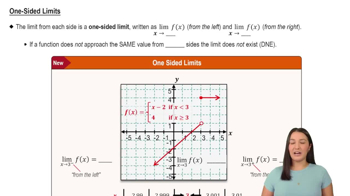
One-Sided Limits

Cosecant Function

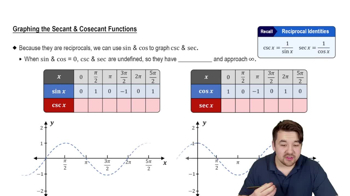
The cosecant function, denoted as csc(x), is the reciprocal of the sine function, defined as csc(x) = 1/sin(x). It is important to note that csc(x) is undefined wherever sin(x) equals zero, which occurs at integer multiples of π. Understanding the behavior of the cosecant function near these points is crucial for evaluating limits involving csc.
Recommended video:
Guided course
6:22
Graphs of Secant and Cosecant Functions

One-Sided Limits

One-sided limits refer to the value that a function approaches as the input approaches a specific point from one side, either the left (denoted as x → a⁻) or the right (denoted as x → a⁺). In this question, we are specifically looking at the left-hand limit of csc(x) as x approaches 0, which requires analyzing the function's behavior as x gets closer to 0 from negative values.
Recommended video:
05:50
One-Sided Limits
Related Practice
Textbook Question

Estimate the following limits using graphs or tables.


lim x→1 9(√2x − x^4 −3√x) / 1 − x^3/4

Textbook Question

If a function f represents a system that varies in time, the existence of lim limtf(t){\(\displaystyle\[\lim\)_{t\(\rightarrow\]\infty\)}{f(t)}} means that the system reaches a steady state (or equilibrium). For the following systems, determine whether a steady state exists and give the steady-state value.


The population of a colony of squirrels is given by p(t)=15003+2e0.1tp\(\left\)(t\(\right\))=\(\frac{1500}{3+2e^{-0.1t}\)}.

Textbook Question

Find all vertical asymptotes x=ax=a of the following functions. For each value of aa, determine limxa+f(x){\(\displaystyle\)\(\lim\)_{x\(\to\) a^{+}}}f\(\left\)(x\(\right\)), limxaf(x){\(\displaystyle\)\(\lim\)_{x\(\to\) a^{-}}}f\(\left\)(x\(\right\)), and limxaf(x){\(\displaystyle\)\(\lim\)_{x\(\to\) a}}f\(\left\)(x\(\right\)).

f(x)=x+1x34x2+4xf\(\left\)(x\(\right\))=\(\frac{x+1}{x^3-4x^2+4x}\)

Textbook Question

Find the intervals on which the following functions are continuous. Specify right- or left-continuity at the finite endpoints.

h(x)=2xx325xh\(\left\)(x\(\right\))=\(\frac{2x}{x^3-25x}\)

6
views
Textbook Question

Determine the interval(s) on which the following functions are continuous. 

p(x)=3x^2−6x+7 / x^2+x+1

Textbook Question

Determine the points on the interval (0, 5) at which the following functions f have discontinuities. At each point of discontinuity, state the conditions in the continuity checklist that are violated. <IMAGE>

20
views