Ch. 2 - Limits
Briggs - Calculus: Early Transcendentals 3rd Edition
Briggs3rd EditionCalculus: Early TranscendentalsISBN: 9780136847243Not the one you use?Change textbook
Chapter 2, Problem 2.6.26

Determine the interval(s) on which the following functions are continuous. 
p(x)=3x^2−6x+7 / x^2+x+1

Verified step by step guidance
1
p>Step 1: Identify the type of function. The given function \( p(x) = \frac{3x^2 - 6x + 7}{x^2 + x + 1} \) is a rational function, which is a ratio of two polynomials.
p>Step 2: Determine the domain of the function. A rational function is continuous everywhere except where its denominator is zero. Therefore, we need to find the values of \( x \) for which \( x^2 + x + 1 = 0 \).
p>Step 3: Solve the equation \( x^2 + x + 1 = 0 \) to find any real roots. Use the quadratic formula \( x = \frac{-b \pm \sqrt{b^2 - 4ac}}{2a} \), where \( a = 1 \), \( b = 1 \), and \( c = 1 \).
p>Step 4: Calculate the discriminant \( b^2 - 4ac \). If the discriminant is negative, the quadratic equation has no real roots, meaning the denominator is never zero for real \( x \).
p>Step 5: Conclude the intervals of continuity. If the denominator has no real roots, the function \( p(x) \) is continuous for all real numbers \( x \).

Verified video answer for a similar problem:

This video solution was recommended by our tutors as helpful for the problem above.
Video duration:
3m
Was this helpful?

Key Concepts

Here are the essential concepts you must grasp in order to answer the question correctly.

Continuity of Functions

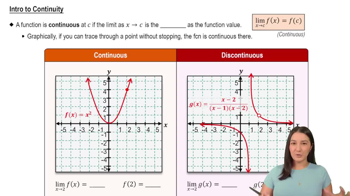
A function is continuous at a point if the limit of the function as it approaches that point equals the function's value at that point. For a function to be continuous over an interval, it must be continuous at every point within that interval. This means there are no breaks, jumps, or asymptotes in the function's graph.
Recommended video:
05:34
Intro to Continuity

Rational Functions

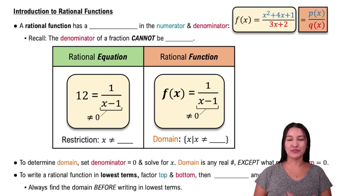
A rational function is a function that can be expressed as the ratio of two polynomials. The continuity of rational functions is determined by the points where the denominator is not equal to zero, as these points can create vertical asymptotes or discontinuities in the function.
Recommended video:
6:04
Intro to Rational Functions

Finding Intervals of Continuity

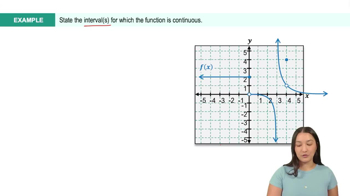
To determine the intervals of continuity for a function, one must identify the values of x that make the denominator zero, as these are the points of discontinuity. The intervals of continuity are then the ranges of x that do not include these points, allowing for a complete analysis of where the function behaves continuously.
Recommended video:
03:38
Intro to Continuity Example 1