Ch. 2 - Limits
Briggs - Calculus: Early Transcendentals 3rd Edition
Briggs3rd EditionCalculus: Early TranscendentalsISBN: 9780136847243Not the one you use?Change textbook
Chapter 2, Problem 2.4.19

Which of the following statements are correct? Choose all that apply.


a. lim x→1 1/ (x−1)^2 does not exist


b. lim x→1 1/ (x−1)^2=∞


c. lim x→1 1/(x−1)^2=−∞

Verified step by step guidance
1
Step 1: Understand the expression given in the limit: \( \lim_{x \to 1} \frac{1}{(x-1)^2} \). This is a rational function where the denominator approaches zero as \( x \) approaches 1.
Step 2: Analyze the behavior of the function as \( x \) approaches 1 from the left (\( x \to 1^- \)) and from the right (\( x \to 1^+ \)). In both cases, \( (x-1)^2 \) approaches zero, but since it is squared, it remains positive.
Step 3: Since the denominator \( (x-1)^2 \) approaches zero and is always positive, the fraction \( \frac{1}{(x-1)^2} \) will increase without bound, indicating that the limit approaches infinity.
Step 4: Evaluate the correctness of each statement: (a) The limit does not exist if it approaches different values from the left and right, but here it approaches the same value (infinity) from both sides. (b) The limit approaches infinity, which is consistent with our analysis. (c) The limit cannot be negative infinity because the denominator is always positive.
Step 5: Conclude that statement (b) is correct, as the limit approaches infinity, while statement (a) is incorrect because the limit does exist (it is infinity), and statement (c) is incorrect because the limit is not negative infinity.

Verified video answer for a similar problem:

This video solution was recommended by our tutors as helpful for the problem above.
Video duration:
2m
Was this helpful?

Key Concepts

Here are the essential concepts you must grasp in order to answer the question correctly.

Limits

In calculus, a limit describes the behavior of a function as its input approaches a certain value. It helps in understanding how functions behave near points of interest, including points where they may not be defined. Evaluating limits is crucial for determining continuity, derivatives, and integrals.
Recommended video:
05:50
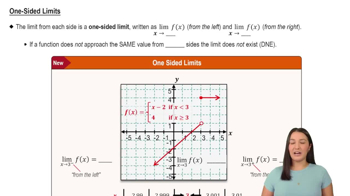
One-Sided Limits

Infinite Limits

An infinite limit occurs when the value of a function increases or decreases without bound as the input approaches a certain point. For example, if the limit of a function approaches infinity, it indicates that the function's values grow larger and larger, which is essential for understanding vertical asymptotes in rational functions.
Recommended video:
05:50
One-Sided Limits

Behavior of Rational Functions

Rational functions are ratios of polynomials, and their limits can exhibit unique behaviors near points where the denominator approaches zero. Understanding how these functions behave near such points, including whether they approach positive or negative infinity, is key to solving limit problems and analyzing their graphs.
Recommended video:
6:04
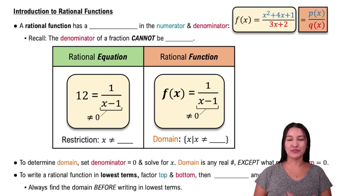
Intro to Rational Functions