Consider the position function s(t)=−16t^2+100t. Complete the following table with the appropriate average velocities. Then make a conjecture about the value of the instantaneous velocity at t=3. <IMAGE>
Ch. 2 - Limits
Briggs3rd EditionCalculus: Early TranscendentalsISBN: 9780136847243Not the one you use?Change textbook
Chapter 2, Problem 2.6.36
Evaluate each limit and justify your answer.
lim x→∞(2x+1x / x)^3
Verified step by step guidance1
Step 1: Simplify the expression inside the limit. Start by rewriting the expression (2x + 1x) / x as (2x + x) / x.
Step 2: Simplify the expression further. Combine like terms in the numerator to get 3x / x.
Step 3: Simplify the fraction 3x / x. Since x is not zero, this simplifies to 3.
Step 4: Substitute the simplified expression back into the limit. The limit becomes lim x→∞ (3)^3.
Step 5: Evaluate the limit. Since 3 is a constant, the limit of a constant as x approaches infinity is simply the constant itself. Therefore, the limit is 3^3.

Verified video answer for a similar problem:
This video solution was recommended by our tutors as helpful for the problem above.
Video duration:
2mWas this helpful?
Key Concepts
Here are the essential concepts you must grasp in order to answer the question correctly.
Limits at Infinity
Limits at infinity involve evaluating the behavior of a function as the input approaches infinity. This concept is crucial for understanding how functions behave for very large values of x, which can often simplify complex expressions. In this case, we analyze how the terms in the expression grow relative to each other as x becomes infinitely large.
Recommended video:
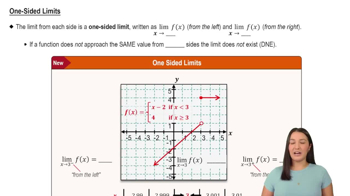
One-Sided Limits
Polynomial Growth
Polynomial growth refers to how polynomial functions behave as their variable approaches infinity. In the expression given, the highest degree term dominates the behavior of the function. Recognizing which terms are significant in the limit helps in simplifying the expression to find the limit more easily.
Recommended video:
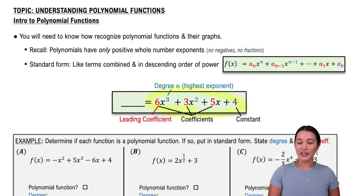
Introduction to Polynomial Functions
Simplifying Rational Expressions
Simplifying rational expressions involves reducing fractions to their simplest form, which can make evaluating limits more straightforward. In this limit problem, simplifying the expression before taking the limit allows for easier computation and clearer insight into the function's behavior as x approaches infinity.
Recommended video:
Simplifying Trig Expressions
Related Practice
Textbook Question
Textbook Question
Determine whether the following functions are continuous at a. Use the continuity checklist to justify your answer.
f(x)=2x^2+3x+1 / x^2+5x; a=−5
Textbook Question
Which of the following statements are correct? Choose all that apply.
a. lim x→1 1/ (x−1)^2 does not exist
b. lim x→1 1/ (x−1)^2=∞
c. lim x→1 1/(x−1)^2=−∞
2
views
Textbook Question
Determine the interval(s) on which the following functions are continuous.
p(x)=3x^2−6x+7 / x^2+x+1
Textbook Question
Determine the following limits at infinity.
lim t→∞ (−12t^−5)
Textbook Question
Determine the points on the interval (0, 5) at which the following functions f have discontinuities. At each point of discontinuity, state the conditions in the continuity checklist that are violated. <IMAGE>
20
views