Ch. 2 - Limits
Briggs - Calculus: Early Transcendentals 3rd Edition
Briggs3rd EditionCalculus: Early TranscendentalsISBN: 9780136847243Not the one you use?Change textbook
Chapter 2, Problem 2.4.13

Suppose f(x)→100 and g(x)→0, with g(x)<0 as x→2. Determine lim x→2 f(x) / g(x).

Verified step by step guidance
1
Identify the given limits: \( \lim_{x \to 2} f(x) = 100 \) and \( \lim_{x \to 2} g(x) = 0 \).
Recognize that \( g(x) < 0 \) as \( x \to 2 \), indicating that \( g(x) \) approaches zero from the negative side.
Apply the limit of a quotient rule: \( \lim_{x \to a} \frac{f(x)}{g(x)} = \frac{\lim_{x \to a} f(x)}{\lim_{x \to a} g(x)} \) if the limits exist and \( \lim_{x \to a} g(x) \neq 0 \).
Since \( \lim_{x \to 2} g(x) = 0 \), the quotient \( \frac{f(x)}{g(x)} \) approaches an indeterminate form of \( \frac{100}{0} \).
Conclude that \( \lim_{x \to 2} \frac{f(x)}{g(x)} \) is undefined and approaches \( -\infty \) because \( g(x) \) approaches zero from the negative side.

Verified video answer for a similar problem:

This video solution was recommended by our tutors as helpful for the problem above.
Video duration:
3m
Was this helpful?

Key Concepts

Here are the essential concepts you must grasp in order to answer the question correctly.

Limits

A limit describes the behavior of a function as its input approaches a certain value. In this case, we are interested in the limits of f(x) and g(x) as x approaches 2. Understanding limits is crucial for evaluating expressions that may not be directly computable at a specific point.
Recommended video:
05:50
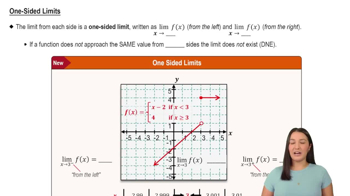
One-Sided Limits

Indeterminate Forms

Indeterminate forms occur in calculus when evaluating limits leads to ambiguous results, such as 100/0. In this scenario, since f(x) approaches 100 and g(x) approaches 0 from the negative side, we need to analyze the limit further to determine the behavior of the quotient.
Recommended video:
Guided course
3:56
Slope-Intercept Form

L'Hôpital's Rule

L'Hôpital's Rule is a method used to evaluate limits of indeterminate forms by differentiating the numerator and denominator. If the limit results in a form like 100/0, applying this rule can help find the limit of the quotient by examining the derivatives of f(x) and g(x) as x approaches 2.
Recommended video:
Related Practice
Textbook Question

Determine the following limits. 


lim x→∞ sin x / e^x

Textbook Question

If a function f represents a system that varies in time, the existence of lim limtf(t){\(\displaystyle\[\lim\)_{t\(\rightarrow\]\infty\)}{f(t)}} means that the system reaches a steady state (or equilibrium). For the following systems, determine whether a steady state exists and give the steady-state value.


The population of a culture of tumor cells is given by p(t)=3500tt+1p\(\left\)(t\(\right\))=\(\frac{3500t}{t+1}\).

Textbook Question

If a function f represents a system that varies in time, the existence of lim limtf(t){\(\displaystyle\[\lim\)_{t\(\rightarrow\]\infty\)}{f(t)}} means that the system reaches a steady state (or equilibrium). For the following systems, determine whether a steady state exists and give the steady-state value.


The population of a colony of squirrels is given by p(t)=15003+2e0.1tp\(\left\)(t\(\right\))=\(\frac{1500}{3+2e^{-0.1t}\)}.

Textbook Question

Find polynomials p and q such that f=p/q is undefined at 1 and 2, but f has a vertical asymptote only at 2. Sketch a graph of your function.

1
views
Textbook Question

Determine the end behavior of the following transcendental functions by analyzing appropriate limits. Then provide a simple sketch of the associated graph, showing asymptotes if they exist. 

f(x)=1lnxf\(\left\)(x\(\right\))=1-\(\ln\) x

1
views
Textbook Question

Let f(x) =x^2−2x+3.


a. For ε=0.25, find the largest value of δ>0 satisfying the statement


|f(x)−2|<ε whenever 0<|x−1|<δ.