Ch. 2 - Limits
Briggs - Calculus: Early Transcendentals 3rd Edition
Briggs3rd EditionCalculus: Early TranscendentalsISBN: 9780136847243Not the one you use?Change textbook
Chapter 2, Problem 2.23

Sketch a graph of f and use it to make a conjecture about the values of f(a), lim x→a^−f(x),lim x→a^+f(x), and lim x→a f(x) or state that they do not exist.
f(x) = x^2−25 / x−5; a=5

Verified step by step guidance
1
Step 1: Identify the function and the point of interest. The function given is \( f(x) = \frac{x^2 - 25}{x - 5} \) and the point of interest is \( a = 5 \).
Step 2: Simplify the function if possible. Notice that \( x^2 - 25 \) can be factored as \( (x - 5)(x + 5) \). Therefore, the function can be rewritten as \( f(x) = \frac{(x - 5)(x + 5)}{x - 5} \).
Step 3: Analyze the simplified function. The \( x - 5 \) terms cancel out, leaving \( f(x) = x + 5 \) for \( x \neq 5 \). This indicates that the function is a line with a hole at \( x = 5 \).
Step 4: Determine the behavior of the function around \( x = 5 \). Since \( f(x) = x + 5 \) for \( x \neq 5 \), as \( x \to 5^- \) and \( x \to 5^+ \), \( f(x) \to 10 \). Thus, \( \lim_{x \to 5^-} f(x) = 10 \) and \( \lim_{x \to 5^+} f(x) = 10 \).
Step 5: Conclude about the limits and the value of \( f(a) \). Since both one-sided limits are equal, \( \lim_{x \to 5} f(x) = 10 \). However, \( f(5) \) is undefined because the original function has a zero in the denominator at \( x = 5 \).

Verified video answer for a similar problem:

This video solution was recommended by our tutors as helpful for the problem above.
Video duration:
6m
Was this helpful?

Key Concepts

Here are the essential concepts you must grasp in order to answer the question correctly.

Limits

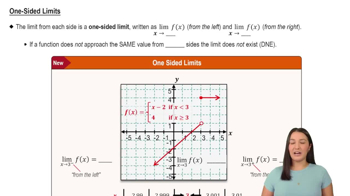
Limits describe the behavior of a function as it approaches a specific point from either side. In this case, we analyze the limits as x approaches 5 from the left (lim x→5^−f(x)) and from the right (lim x→5^+f(x)). Understanding limits is crucial for determining the continuity and behavior of the function at that point.
Recommended video:
05:50
One-Sided Limits

Continuity

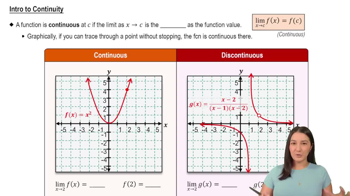
A function is continuous at a point if the limit as x approaches that point equals the function's value at that point. For the function f(x) = (x^2−25)/(x−5), we need to check if f(5) exists and if it matches the limits from both sides. If the function is not continuous at a, it may indicate a hole or vertical asymptote.
Recommended video:
05:34
Intro to Continuity

Graphing Rational Functions

Graphing rational functions involves identifying key features such as holes, vertical asymptotes, and intercepts. For f(x) = (x^2−25)/(x−5), we can simplify it to f(x) = x + 5 for x ≠ 5, which helps visualize the function's behavior around x = 5. This understanding aids in making conjectures about the function's values and limits.
Recommended video:
5:53
Graph of Sine and Cosine Function