Suppose f(x)→100 and g(x)→0, with g(x)<0 as x→2. Determine lim x→2 f(x) / g(x).
Ch. 2 - Limits
Briggs3rd EditionCalculus: Early TranscendentalsISBN: 9780136847243Not the one you use?Change textbook
Chapter 2, Problem 2.5.59
Determine the end behavior of the following transcendental functions by analyzing appropriate limits. Then provide a simple sketch of the associated graph, showing asymptotes if they exist.
Verified step by step guidance1

Verified video answer for a similar problem:
This video solution was recommended by our tutors as helpful for the problem above.
Video duration:
12mWas this helpful?
Key Concepts
Here are the essential concepts you must grasp in order to answer the question correctly.
Limits
Limits are fundamental in calculus, representing the value that a function approaches as the input approaches a certain point. They are crucial for analyzing the end behavior of functions, particularly as the input approaches infinity or a specific value. Understanding limits allows us to determine how functions behave at extreme values, which is essential for sketching graphs and identifying asymptotes.
Recommended video:
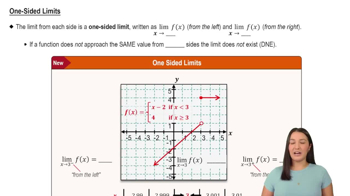
One-Sided Limits
Transcendental Functions
Transcendental functions, such as logarithmic, exponential, and trigonometric functions, are not algebraic and cannot be expressed as roots of polynomial equations. The function in the question, f(x) = 1 - ln(x), is a logarithmic function, which has unique properties affecting its limits and end behavior. Recognizing the characteristics of transcendental functions is vital for accurately analyzing their behavior and sketching their graphs.
Recommended video:
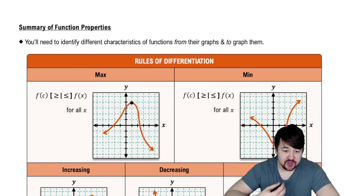
Properties of Functions
Asymptotes
Asymptotes are lines that a graph approaches but never touches, indicating the behavior of a function as it tends towards infinity or a specific value. There are vertical, horizontal, and oblique asymptotes, each providing insight into the function's end behavior. Identifying asymptotes is essential for sketching accurate graphs, as they help illustrate how the function behaves at extreme values and around points of discontinuity.
Recommended video:
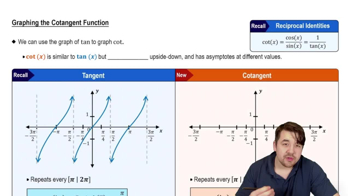
Introduction to Cotangent Graph
Related Practice
Textbook Question
1
views
Textbook Question
Determine the following limits.
lim x→∞ sin x / e^x
Textbook Question
If a function f represents a system that varies in time, the existence of lim means that the system reaches a steady state (or equilibrium). For the following systems, determine whether a steady state exists and give the steady-state value.
The population of a culture of tumor cells is given by .
Textbook Question
Let
a. Determine the value of a for which is continuous from the left at .
Textbook Question
Use the precise definition of a limit to prove the following limits. Specify a relationship between ε and δ that guarantees the limit exists.
lim x→7 f(x)=9, where f(x)={3x−12 if x≤7
x+2 if x>7
Textbook Question
Let f(x) =x^2−2x+3.
a. For ε=0.25, find the largest value of δ>0 satisfying the statement
|f(x)−2|<ε whenever 0<|x−1|<δ.