Ch. 2 - Limits
Briggs - Calculus: Early Transcendentals 3rd Edition
Briggs3rd EditionCalculus: Early TranscendentalsISBN: 9780136847243Not the one you use?Change textbook
Chapter 2, Problem 2.7.25

Use the precise definition of a limit to prove the following limits. Specify a relationship between ε and δ that guarantees the limit exists.
lim x→7 f(x)=9, where f(x)={3x−12 if x≤7
x+2 if x>7

Verified step by step guidance
1
We need to prove that \( \lim_{{x \to 7}} f(x) = 9 \) using the precise definition of a limit. The function \( f(x) \) is defined piecewise: \( f(x) = 3x - 12 \) for \( x \leq 7 \) and \( f(x) = x + 2 \) for \( x > 7 \).
The precise definition of a limit states that for every \( \varepsilon > 0 \), there exists a \( \delta > 0 \) such that if \( 0 < |x - 7| < \delta \), then \( |f(x) - 9| < \varepsilon \).
For \( x \leq 7 \), \( f(x) = 3x - 12 \). We need \( |(3x - 12) - 9| < \varepsilon \). Simplifying, this becomes \( |3x - 21| < \varepsilon \), or \( |3(x - 7)| < \varepsilon \).
From \( |3(x - 7)| < \varepsilon \), we have \( |x - 7| < \frac{\varepsilon}{3} \). Thus, for \( x \leq 7 \), we can choose \( \delta = \frac{\varepsilon}{3} \).
7 \).> For \( x > 7 \), \( f(x) = x + 2 \). We need \( |(x + 2) - 9| < \varepsilon \). Simplifying, this becomes \( |x - 7| < \varepsilon \). Thus, for \( x > 7 \), we can choose \( \delta = \varepsilon \).

Verified video answer for a similar problem:

This video solution was recommended by our tutors as helpful for the problem above.
Video duration:
3m
Was this helpful?

Key Concepts

Here are the essential concepts you must grasp in order to answer the question correctly.

Definition of a Limit

The precise definition of a limit states that for a function f(x) to approach a limit L as x approaches a value c, for every ε > 0, there must exist a δ > 0 such that if 0 < |x - c| < δ, then |f(x) - L| < ε. This formal definition is crucial for proving limits rigorously.
Recommended video:
05:50
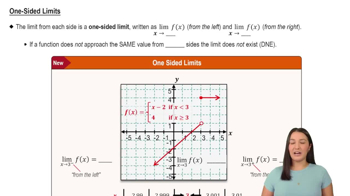
One-Sided Limits

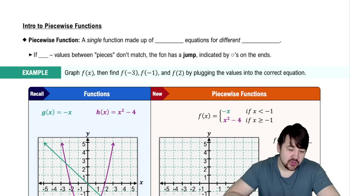
Piecewise Functions

A piecewise function is defined by different expressions based on the input value. In this case, f(x) has two definitions: 3x - 12 for x ≤ 7 and x + 2 for x > 7. Understanding how to evaluate limits at points where the function changes its definition is essential for solving the limit problem.
Recommended video:
05:36
Piecewise Functions

Epsilon-Delta Proof

An epsilon-delta proof involves demonstrating that for any chosen ε, a corresponding δ can be found that satisfies the limit definition. This method is used to show that as x approaches a certain value, the function's output can be made arbitrarily close to the limit, thus confirming the limit's existence.
Recommended video:
Guided course
3:56
Slope-Intercept Form
Related Practice
Textbook Question

Estimate the following limits using graphs or tables.


lim x→1 9(√2x − x^4 −3√x) / 1 − x^3/4

Textbook Question

If a function f represents a system that varies in time, the existence of lim limtf(t){\(\displaystyle\[\lim\)_{t\(\rightarrow\]\infty\)}{f(t)}} means that the system reaches a steady state (or equilibrium). For the following systems, determine whether a steady state exists and give the steady-state value.


The population of a culture of tumor cells is given by p(t)=3500tt+1p\(\left\)(t\(\right\))=\(\frac{3500t}{t+1}\).

Textbook Question

Find the following limits or state that they do not exist. Assume a, b , c, and k are fixed real numbers.


lim x→3 −5x / √4x − 3

2
views
Textbook Question

Let g(x)={x2+xif x<1aif x=13x+5if x>1g\(\left\)(x\(\right\))=\(\begin{cases}\)x^2+x & \(\text{if }\)x<1\\ a & \(\text{if }\)x=1\\ 3x+5 & \(\text{if }\)x>1\(\end{cases}\)

a. Determine the value of a for which gg is continuous from the left at 11.

Textbook Question

Determine the interval(s) on which the following functions are continuous. At which finite endpoints of the intervals of continuity is f continuous from the left or continuous from the right? 


f(x)=(2x−3)^2/3

Textbook Question

Determine the end behavior of the following transcendental functions by analyzing appropriate limits. Then provide a simple sketch of the associated graph, showing asymptotes if they exist. 

f(x)=1lnxf\(\left\)(x\(\right\))=1-\(\ln\) x

1
views