Ch. 2 - Limits
Briggs - Calculus: Early Transcendentals 3rd Edition
Briggs3rd EditionCalculus: Early TranscendentalsISBN: 9780136847243Not the one you use?Change textbook
Chapter 2, Problem 2.13

Determine the following limits at infinity.


lim t→∞ et,lim t→−∞ e^t,and lim t→∞ e^−t

Verified step by step guidance
1
Consider the function \(e^t\). As \(t\) approaches infinity, \(e^t\) grows exponentially without bound. Therefore, \(\lim_{t \to \infty} e^t = \infty\).
Now, consider the function \(e^t\) as \(t\) approaches negative infinity. As \(t\) becomes more negative, \(e^t\) approaches zero because the exponential function decays rapidly. Therefore, \(\lim_{t \to -\infty} e^t = 0\).
Next, consider the function \(e^{-t}\) as \(t\) approaches infinity. Notice that \(e^{-t} = \frac{1}{e^t}\). As \(t\) becomes very large, \(e^t\) becomes very large, making \(\frac{1}{e^t}\) approach zero. Therefore, \(\lim_{t \to \infty} e^{-t} = 0\).

Verified video answer for a similar problem:

This video solution was recommended by our tutors as helpful for the problem above.
Video duration:
6m
Was this helpful?

Key Concepts

Here are the essential concepts you must grasp in order to answer the question correctly.

Limits at Infinity

Limits at infinity refer to the behavior of a function as the input approaches positive or negative infinity. Understanding these limits helps determine the end behavior of functions, which is crucial in calculus for analyzing asymptotic behavior and graphing functions.
Recommended video:
05:50
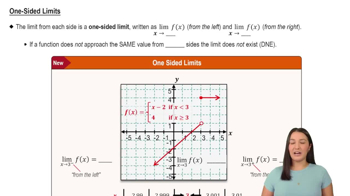
One-Sided Limits

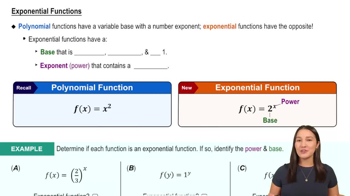
Exponential Functions

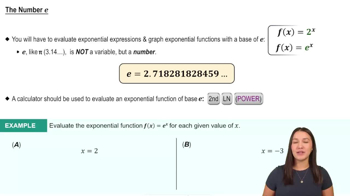
Exponential functions, such as e^t, are functions of the form f(t) = a^t, where 'a' is a positive constant. The base 'e' (approximately 2.718) is particularly important in calculus due to its unique properties, including its derivative being equal to the function itself, which simplifies many calculations involving growth and decay.
Recommended video:
6:13
Exponential Functions

Behavior of e^t and e^−t

The function e^t grows rapidly as t approaches infinity, leading to a limit of infinity. Conversely, e^−t approaches zero as t approaches infinity, indicating decay. Understanding these behaviors is essential for evaluating the specified limits and interpreting their implications in various contexts.
Recommended video:
4:47
The Number e