Ch. 2 - Limits
Briggs - Calculus: Early Transcendentals 3rd Edition
Briggs3rd EditionCalculus: Early TranscendentalsISBN: 9780136847243Not the one you use?Change textbook
Chapter 2, Problem 2.7.48

Use the precise definition of infinite limits to prove the following limits.


limx0(1x4sin(x))={\(\displaystyle\[\lim\)_{x\(\to\)0}}\(\left\)(\(\frac{1}{x^4}\)-\(\sin\]\left\)(x\(\right\))\(\right\))=\(\infty\)

Verified step by step guidance
1
Step 1: Understand the definition of an infinite limit. The limit \( \lim_{x \to a} f(x) = \infty \) means that for every positive number \( M \), there exists a \( \delta > 0 \) such that if \( 0 < |x - a| < \delta \), then \( f(x) > M \).
Step 2: Consider the function \( f(x) = \frac{1}{x^4} - \sin(x) \). As \( x \to 0 \), \( \frac{1}{x^4} \to \infty \) and \( \sin(x) \to 0 \). Therefore, \( f(x) \to \infty \).
Step 3: For a given \( M > 0 \), we need to find \( \delta > 0 \) such that if \( 0 < |x| < \delta \), then \( \frac{1}{x^4} - \sin(x) > M \).
Step 4: Since \( \sin(x) \) is bounded, \( |\sin(x)| \leq |x| \). Therefore, \( \frac{1}{x^4} - \sin(x) \geq \frac{1}{x^4} - |x| \).
Step 5: Choose \( \delta \) small enough such that \( \frac{1}{x^4} - |x| > M \) for \( 0 < |x| < \delta \). This ensures that \( \frac{1}{x^4} - \sin(x) > M \), proving the limit is infinite.

Verified video answer for a similar problem:

This video solution was recommended by our tutors as helpful for the problem above.
Video duration:
8m
Was this helpful?

Key Concepts

Here are the essential concepts you must grasp in order to answer the question correctly.

Infinite Limits

Infinite limits describe the behavior of a function as the input approaches a certain value, where the function's output grows without bound. Specifically, if the limit of a function as x approaches a value results in infinity, it indicates that the function increases indefinitely in that vicinity. Understanding infinite limits is crucial for analyzing functions that exhibit vertical asymptotes or unbounded growth.
Recommended video:
05:50
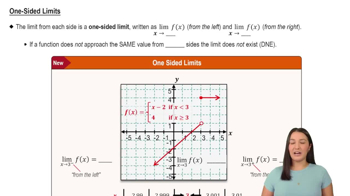
One-Sided Limits

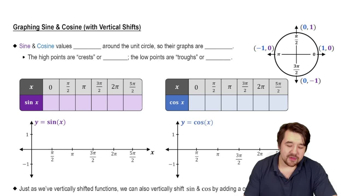
Sine Function Behavior

The sine function, denoted as sin(x), oscillates between -1 and 1 for all real numbers x. As x approaches 0, sin(x) can be approximated by its Taylor series expansion, which shows that sin(x) behaves like x near zero. This property is essential for evaluating limits involving sin(x) and understanding how it interacts with other functions, particularly in the context of limits approaching zero.
Recommended video:
5:53
Graph of Sine and Cosine Function

Limit Definition and Evaluation

The precise definition of a limit involves the concept of approaching a value as closely as desired. To prove limits, one often uses algebraic manipulation, substitution, or the epsilon-delta definition. In this case, evaluating the limit requires analyzing the expression as x approaches 0, particularly focusing on the dominant term in the expression, which is crucial for determining the limit's behavior.
Recommended video:
05:43
Definition of the Definite Integral