Consider the position function s(t)=−16t^2+100t. Complete the following table with the appropriate average velocities. Then make a conjecture about the value of the instantaneous velocity at t=3. <IMAGE>
Ch. 2 - Limits
Briggs3rd EditionCalculus: Early TranscendentalsISBN: 9780136847243Not the one you use?Change textbook
Chapter 2, Problem 2.4.42
Determine the following limits.
Verified step by step guidance1
Step 1: Understand the problem. We need to find the limit of the function \( \frac{1}{3} \tan(\theta) \) as \( \theta \) approaches \( \frac{\pi}{2}^+ \). This means we are considering values of \( \theta \) that are slightly greater than \( \frac{\pi}{2} \).
Step 2: Analyze the behavior of \( \tan(\theta) \) near \( \frac{\pi}{2} \). The tangent function, \( \tan(\theta) = \frac{\sin(\theta)}{\cos(\theta)} \), becomes undefined at \( \theta = \frac{\pi}{2} \) because \( \cos(\theta) = 0 \) at this point.
Step 3: Consider the right-hand limit. As \( \theta \) approaches \( \frac{\pi}{2}^+ \), \( \cos(\theta) \) approaches 0 from the negative side, making \( \tan(\theta) \) approach \(-\infty \).
Step 4: Apply the limit to the function. Since \( \tan(\theta) \to -\infty \) as \( \theta \to \frac{\pi}{2}^+ \), the expression \( \frac{1}{3} \tan(\theta) \) will also approach \(-\infty \).
Step 5: Conclude the limit. Therefore, the limit \( \lim_{\theta \to \frac{\pi}{2}^+} \frac{1}{3} \tan(\theta) = -\infty \).

Verified video answer for a similar problem:
This video solution was recommended by our tutors as helpful for the problem above.
Video duration:
5mWas this helpful?
Key Concepts
Here are the essential concepts you must grasp in order to answer the question correctly.
Limits
Limits are fundamental concepts in calculus that describe the behavior of a function as its input approaches a certain value. They help in understanding how functions behave near points of interest, including points where they may not be defined. In this case, we are examining the limit of the tangent function as the angle approaches π/2 from the right, which is crucial for determining the function's behavior near that point.
Recommended video:
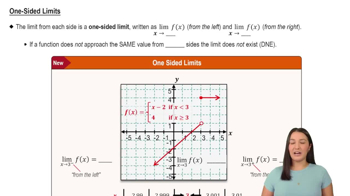
One-Sided Limits
Tangent Function
The tangent function, denoted as tan(θ), is a trigonometric function defined as the ratio of the opposite side to the adjacent side in a right triangle. It can also be expressed as sin(θ)/cos(θ). As θ approaches π/2, the cosine of θ approaches zero, causing the tangent function to approach infinity, which is essential for evaluating the limit in the given question.
Recommended video:
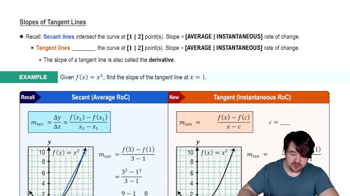
Slopes of Tangent Lines
One-Sided Limits
One-sided limits refer to the value that a function approaches as the input approaches a specific point from one side only, either from the left or the right. In this problem, we are interested in the limit as θ approaches π/2 from the right (denoted as θ → π/2⁺), which is important because the behavior of the tangent function differs when approaching from different directions, particularly near vertical asymptotes.
Recommended video:
One-Sided Limits
Related Practice
Textbook Question
Textbook Question
Use the precise definition of a limit to prove the following limits. Specify a relationship between ε and δ that guarantees the limit exists.
lim x→0 x^2=0 (Hint: Use the identity √x2=|x|.)
Textbook Question
Determine the following limits at infinity.
lim t→∞ et,lim t→−∞ e^t,and lim t→∞ e^−t
Textbook Question
a. Analyze and for each function.
1
views
Textbook Question
Use the precise definition of infinite limits to prove the following limits.
Textbook Question
Determine the points on the interval (0, 5) at which the following functions f have discontinuities. At each point of discontinuity, state the conditions in the continuity checklist that are violated. <IMAGE>
20
views