
Ch. 2 - Limits
Briggs - Calculus: Early Transcendentals 3rd Edition
Briggs3rd EditionCalculus: Early TranscendentalsISBN: 9780136847243Not the one you use?Change textbook
Chapter 2, Problem 2.49

Evaluate each limit. 
lim x→2 √4x+10 / 2x−2

Verified step by step guidance
1
Identify the limit expression: \( \lim_{{x \to 2}} \frac{\sqrt{4x+10}}{2x-2} \).
Substitute \( x = 2 \) into the expression to check if it results in an indeterminate form.
Notice that substituting \( x = 2 \) gives \( \frac{\sqrt{4(2)+10}}{2(2)-2} = \frac{\sqrt{18}}{2} \), which is not an indeterminate form.
Simplify the expression \( \frac{\sqrt{18}}{2} \) by recognizing that \( \sqrt{18} = \sqrt{9 \times 2} = 3\sqrt{2} \).
Conclude that the limit is \( \frac{3\sqrt{2}}{2} \).

Verified video answer for a similar problem:

This video solution was recommended by our tutors as helpful for the problem above.
Video duration:
3m
Was this helpful?

Key Concepts

Here are the essential concepts you must grasp in order to answer the question correctly.

Limits

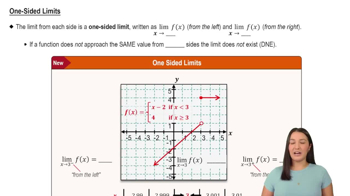
A limit is a fundamental concept in calculus that describes the behavior of a function as its input approaches a certain value. It helps in understanding how functions behave near specific points, which is crucial for evaluating expressions that may be undefined at those points. In this case, we are interested in the limit as x approaches 2.
Recommended video:
05:50
One-Sided Limits

Rational Functions

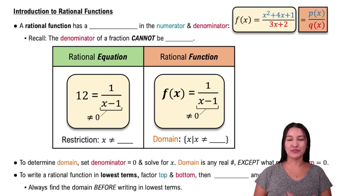
Rational functions are expressions formed by the ratio of two polynomials. In the given limit, the expression involves a square root in the numerator and a linear polynomial in the denominator. Understanding how to simplify or manipulate these functions is essential for evaluating limits, especially when direct substitution leads to indeterminate forms.
Recommended video:
6:04
Intro to Rational Functions

Substitution and Simplification

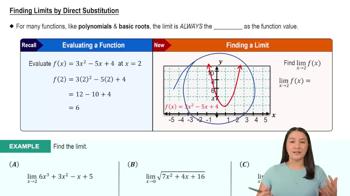
Substitution and simplification are techniques used in calculus to evaluate limits. When direct substitution results in an indeterminate form, such as 0/0, it is often necessary to simplify the expression or use algebraic manipulation to find the limit. This may involve factoring, rationalizing, or applying L'Hôpital's Rule to resolve the limit effectively.
Recommended video:
05:21
Finding Limits by Direct Substitution
Related Practice
Textbook Question

If a function f represents a system that varies in time, the existence of lim limtf(t){\(\displaystyle\[\lim\)_{t\(\rightarrow\]\infty\)}{f(t)}} means that the system reaches a steady state (or equilibrium). For the following systems, determine whether a steady state exists and give the steady-state value.


The population of a colony of squirrels is given by p(t)=15003+2e0.1tp\(\left\)(t\(\right\))=\(\frac{1500}{3+2e^{-0.1t}\)}.

Textbook Question

Determine the following limits.


limx0csc(x){\(\displaystyle\[\lim\)_{x\(\to\)0^{-}}}\(\csc\]\left\)(x\(\right\))

3
views
Textbook Question

Find all vertical asymptotes x=ax=a of the following functions. For each value of aa, determine limxa+f(x){\(\displaystyle\]\lim\)_{x\(\to\) a^{+}}}f\(\left\)(x\(\right\)), limxaf(x){\(\displaystyle\]\lim\)_{x\(\to\) a^{-}}}f\(\left\)(x\(\right\)), and limxaf(x){\(\displaystyle\]\lim\)_{x\(\to\) a}}f\(\left\)(x\(\right\)).

f(x)=x+1x34x2+4xf\(\left\)(x\(\right\))=\(\frac{x+1}{x^3-4x^2+4x}\)

Textbook Question

Determine limxf(x)\(\lim\)_{x\(\rightarrow\]\infty\)}f\(\left\)(x\(\right\)) and limxf(x)\(\lim\)_{x\(\rightarrow\)-\(\infty\)}f\(\left\)(x\(\right\)) for the following functions. Then give the horizontal asymptotes of ff (if any).


f(x)=40x5+x216x42xf\(\left\)(x\(\right\))=\(\frac{40x^5+x^2}{16x^4-2x}\)

Textbook Question

Use analytical methods and/or a graphing utility to identify the vertical asymptotes (if any) of the following functions.

h(x)=e^x(x+1)^3

Textbook Question

The following table gives the position s(t)s\(\left\)(t\(\right\)) of an object moving along a line at time tt. Determine the average velocities over the time intervals [1,1.01]\(\left\[\lbrack\)1,1.01\(\right\]\rbrack\), [1,1.001]\(\left\[\lbrack\)1,1.001\(\right\]\rbrack\), and [1,1.0001]\(\left\]\lbrack\)1,1.0001^{}\(\right\).]. Then make a conjecture about the value of the instantaneous velocity at t=1t=1. <IMAGE>