Find all vertical asymptotes of the following functions. For each value of , determine , , and .
Ch. 2 - Limits
Briggs3rd EditionCalculus: Early TranscendentalsISBN: 9780136847243Not the one you use?Change textbook
Chapter 2, Problem 2.5.43
Determine and for the following functions. Then give the horizontal asymptotes of (if any).
Verified step by step guidance1
Identify the degrees of the polynomials in the numerator and the denominator. The numerator is 40x^5 + x^2, which has a degree of 5, and the denominator is 16x^4 - 2x, which has a degree of 4.
Since the degree of the numerator (5) is greater than the degree of the denominator (4), the limit as x approaches infinity will be infinity. This means there is no horizontal asymptote as x approaches infinity.
To find the limit as x approaches negative infinity, observe that the behavior will be similar to the limit as x approaches positive infinity because the highest degree terms dominate. Thus, the limit as x approaches negative infinity will also be infinity, indicating no horizontal asymptote in this direction either.
For a more precise analysis, divide every term in the numerator and the denominator by x^5, the highest power of x in the numerator. This simplifies the expression to (40 + x^(-3))/(16x^(-1) - 2x^(-4)).
As x approaches infinity or negative infinity, the terms with negative exponents approach zero, simplifying the expression to 40/0, which confirms that the limits are infinite and there are no horizontal asymptotes.

Verified video answer for a similar problem:
This video solution was recommended by our tutors as helpful for the problem above.
Video duration:
5mWas this helpful?
Key Concepts
Here are the essential concepts you must grasp in order to answer the question correctly.
Limits at Infinity
Limits at infinity describe the behavior of a function as the input approaches positive or negative infinity. This concept is crucial for understanding how functions behave in extreme cases, allowing us to determine horizontal asymptotes. For example, if the limit of f(x) as x approaches infinity is a constant, it indicates that the function approaches that constant value, suggesting a horizontal asymptote.
Recommended video:
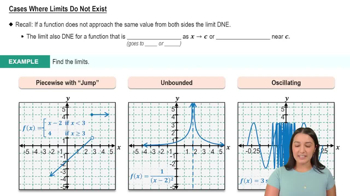
Cases Where Limits Do Not Exist
Horizontal Asymptotes
Horizontal asymptotes are lines that a graph approaches as x approaches infinity or negative infinity. They provide insight into the end behavior of a function. If a function has a horizontal asymptote at y = c, it means that as x becomes very large or very small, the function's value gets closer to c, indicating stability in the function's output at extreme values.
Recommended video:
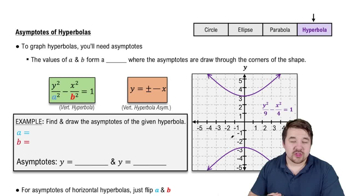
Asymptotes of Hyperbolas
Rational Functions
Rational functions are ratios of polynomials, expressed in the form f(x) = P(x)/Q(x), where P and Q are polynomials. The degrees of these polynomials play a significant role in determining the limits at infinity and the existence of horizontal asymptotes. For instance, if the degree of the numerator is greater than the degree of the denominator, the limit as x approaches infinity will be infinite, indicating no horizontal asymptote.
Recommended video:
Intro to Rational Functions
Related Practice
Textbook Question
Textbook Question
Consider the position function s(t)=−16t^2+128t (Exercise 13). Complete the following table with the appropriate average velocities. Then make a conjecture about the value of the instantaneous velocity at t=1. <IMAGE>
Textbook Question
Use analytical methods and/or a graphing utility to identify the vertical asymptotes (if any) of the following functions.
h(x)=e^x(x+1)^3
Textbook Question
The following table gives the position of an object moving along a line at time . Determine the average velocities over the time intervals , , and . Then make a conjecture about the value of the instantaneous velocity at . <IMAGE>
Textbook Question
Evaluate each limit and justify your answer.
lim x→1 (x+5x / x+2)^4
Textbook Question
Evaluate each limit.
lim x→2 √4x+10 / 2x−2
3
views