
Ch. 2 - Limits
Briggs - Calculus: Early Transcendentals 3rd Edition
Briggs3rd EditionCalculus: Early TranscendentalsISBN: 9780136847243Not the one you use?Change textbook
Chapter 2, Problem 2.R.35

Determine the following limits.
lim x→∞ (2x − 3) / (4x + 10)

Verified step by step guidance
1
Identify the highest degree terms in the numerator and the denominator. In this case, both are linear terms: \$2x$ in the numerator and \$4x$ in the denominator.
Divide every term in the numerator and the denominator by \(x\), the highest power of \(x\) present in the expression.
Rewrite the expression as \(\frac{2x/x - 3/x}{4x/x + 10/x}\), which simplifies to \(\frac{2 - 3/x}{4 + 10/x}\).
As \(x\) approaches infinity, the terms \(3/x\) and \(10/x\) approach zero.
Evaluate the limit of the simplified expression \(\frac{2 - 0}{4 + 0}\), which simplifies to \(\frac{2}{4}\).

Verified video answer for a similar problem:

This video solution was recommended by our tutors as helpful for the problem above.
Video duration:
3m

Key Concepts

Here are the essential concepts you must grasp in order to answer the question correctly.

Limits at Infinity

Limits at infinity involve evaluating the behavior of a function as the input approaches infinity. This concept is crucial for understanding how functions behave for very large values of x, which can help determine horizontal asymptotes and overall end behavior.
Recommended video:
05:50
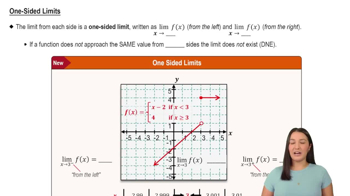
One-Sided Limits

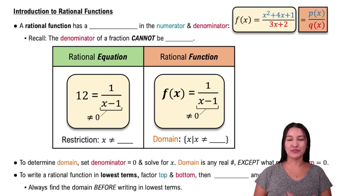
Rational Functions

A rational function is a ratio of two polynomials. In the limit problem presented, recognizing that both the numerator and denominator are polynomials allows us to simplify the expression by focusing on the leading terms, which dominate the behavior as x approaches infinity.
Recommended video:
6:04
Intro to Rational Functions

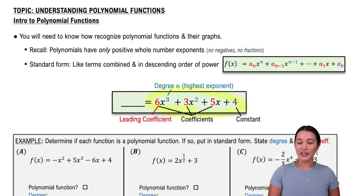
Leading Coefficients

The leading coefficients of the highest degree terms in the numerator and denominator play a key role in determining the limit of a rational function as x approaches infinity. For the limit in question, the leading terms (2x and 4x) dictate the limit's value, allowing for straightforward simplification.
Recommended video:
6:04
Introduction to Polynomial Functions
Related Practice
Textbook Question

The height above the ground of a stone thrown upwards is given by s(t), where t is measured in seconds. After 1 second, the height of the stone is 48 feet above the ground, and after 1.5 seconds, the height of the stone is 60 feet above the ground. Evaluate s(1) and s(1.5), and then find the average velocity of the stone over the time interval [1, 1.5].

Textbook Question

Suppose the rental cost for a snowboard is \$25 for the first day (or any part of the first day) plus \$15 for each additional day (or any part of a day).

e. For what values of t is f continuous? Explain.

Textbook Question

Evaluate limxf(x){\(\displaystyle\[\lim\)_{x\(\to\]\infty\)}{f(x)}} andlimxf(x){\(\displaystyle\)\(\lim\)_{x\(\to\)-\(\infty\)}{f(x)}}.


f(x)=1e2xf\(\left\)(x\(\right\))=1-e^{-2x}

Textbook Question

Find the intervals on which the following functions are continuous. Specify right- or left-continuity at the finite endpoints.

g(x)=cos(ex)g\(\left\)(x\(\right\))=\(\cos\)\(\left\)(e^{x}\(\right\))

1
views
Textbook Question

Use the graph of ff in the figure to determine the values of xx in the interval (3,5)\(\left\)(-3,5\(\right\)) at which f fails to be continuous. Justify your answers using the continuity checklist.

<IMAGE>

4
views
Textbook Question

Let g(x)={5x2if x<1aif x=1ax2+bxif x>1g\(\left\)(x\(\right\))=\(\begin{cases}\)5x-2 & \(\text{if }\)x<1\\ a & \(\text{if }\)x=1\\ ax^2+bx & \(\text{if }\)x>1\(\end{cases}\).


Determine values of the constants aa and bb , if possible, for which gg is continuous at x=1x=1.