Ch. 2 - Limits
Briggs - Calculus: Early Transcendentals 3rd Edition
Briggs3rd EditionCalculus: Early TranscendentalsISBN: 9780136847243Not the one you use?Change textbook
Chapter 2, Problem 2.R.2

The height above the ground of a stone thrown upwards is given by s(t), where t is measured in seconds. After 1 second, the height of the stone is 48 feet above the ground, and after 1.5 seconds, the height of the stone is 60 feet above the ground. Evaluate s(1) and s(1.5), and then find the average velocity of the stone over the time interval [1, 1.5].

Verified step by step guidance
1
First, understand that s(t) represents the height of the stone at time t. We are given s(1) = 48 feet and s(1.5) = 60 feet. These values indicate the height of the stone at 1 second and 1.5 seconds, respectively.
To find the average velocity of the stone over the time interval [1, 1.5], use the formula for average velocity: \( v_{avg} = \frac{s(t_2) - s(t_1)}{t_2 - t_1} \), where \( t_1 = 1 \) and \( t_2 = 1.5 \).
Substitute the given values into the average velocity formula: \( v_{avg} = \frac{s(1.5) - s(1)}{1.5 - 1} \).
Calculate the difference in height: \( s(1.5) - s(1) = 60 - 48 \).
Divide the difference in height by the difference in time: \( v_{avg} = \frac{12}{0.5} \). This will give you the average velocity of the stone over the interval [1, 1.5].

Verified video answer for a similar problem:

This video solution was recommended by our tutors as helpful for the problem above.
Video duration:
2m
Was this helpful?

Key Concepts

Here are the essential concepts you must grasp in order to answer the question correctly.

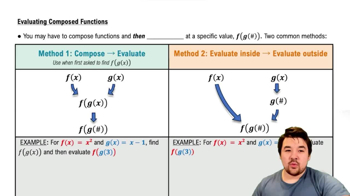
Function Evaluation

Function evaluation involves substituting a specific input value into a function to determine its output. In this context, evaluating s(1) and s(1.5) means finding the height of the stone at 1 second and 1.5 seconds, respectively. This is crucial for understanding the stone's position at those specific times.
Recommended video:
4:26
Evaluating Composed Functions

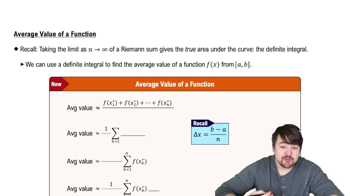
Average Velocity

Average velocity is defined as the change in position over the change in time. It can be calculated using the formula (s(t2) - s(t1)) / (t2 - t1). In this problem, the average velocity of the stone over the interval [1, 1.5] is determined by finding the difference in height at these two times and dividing by the time interval.
Recommended video:
06:37
Average Value of a Function

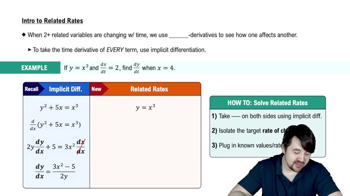
Rate of Change

Rate of change refers to how a quantity changes with respect to another variable, often time. In calculus, this concept is fundamental for understanding motion, as it relates to how quickly the height of the stone changes as time progresses. The average velocity calculated in this problem is a specific instance of the rate of change of the stone's height with respect to time.
Recommended video:
04:16
Intro To Related Rates