
The height above the ground of a stone thrown upwards is given by s(t), where t is measured in seconds. After 1 second, the height of the stone is 48 feet above the ground, and after 1.5 seconds, the height of the stone is 60 feet above the ground. Evaluate s(1) and s(1.5), and then find the average velocity of the stone over the time interval [1, 1.5].
Ch. 2 - Limits
Briggs3rd EditionCalculus: Early TranscendentalsISBN: 9780136847243Not the one you use?Change textbook
Chapter 2, Problem 2.R.78
Find the intervals on which the following functions are continuous. Specify right- or left-continuity at the finite endpoints.
Verified step by step guidance1
Step 1: Identify the components of the function g(x) = cos(e^x). The function is composed of an exponential function e^x and a trigonometric function cos(x).
Step 2: Determine the continuity of the inner function e^x. The exponential function e^x is continuous for all real numbers x.
Step 3: Determine the continuity of the outer function cos(x). The cosine function is continuous for all real numbers.
Step 4: Use the composition of continuous functions theorem. Since both e^x and cos(x) are continuous for all real numbers, their composition g(x) = cos(e^x) is also continuous for all real numbers.
Step 5: Conclude that g(x) = cos(e^x) is continuous on the interval (-∞, ∞). There are no finite endpoints to consider for right- or left-continuity.

Verified video answer for a similar problem:
This video solution was recommended by our tutors as helpful for the problem above.
Video duration:
2mWas this helpful?
Key Concepts
Here are the essential concepts you must grasp in order to answer the question correctly.
Continuity of Functions
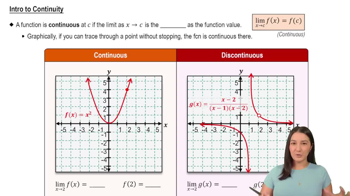
A function is continuous at a point if the limit of the function as it approaches that point equals the function's value at that point. For a function to be continuous over an interval, it must be continuous at every point within that interval. This concept is crucial for determining where a function does not have breaks, jumps, or asymptotes.
Recommended video:
Intro to Continuity
Endpoints and Continuity
When analyzing the continuity of functions on closed intervals, special attention must be given to the endpoints. A function can be left-continuous at the left endpoint and right-continuous at the right endpoint. Understanding how a function behaves at these endpoints is essential for accurately describing its continuity over the entire interval.
Recommended video:
Intro to Continuity
Behavior of Composite Functions
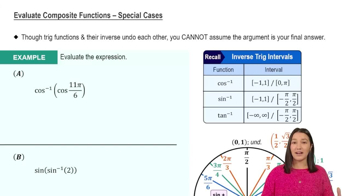
The function g(x) = cos(e^x) is a composite function, where the continuity of g depends on the continuity of both the cosine function and the exponential function. Since both functions are continuous everywhere, g(x) is also continuous for all real numbers. Recognizing how the continuity of inner and outer functions affects the overall function is vital in calculus.
Recommended video:
Evaluate Composite Functions - Special Cases
Related Practice
Textbook Question
Textbook Question
b. Estimate a solution to the equation in the given interval using a root finder.
x=cos x; (0,π/2)
Textbook Question
Determine the following limits.
lim x→∞ (3 tan-1 x + 2)
1
views
Textbook Question
Determine the following limits.
lim x→∞ (2x − 3) / (4x + 10)
Textbook Question
Use the graph of in the figure to determine the values of in the interval at which f fails to be continuous. Justify your answers using the continuity checklist.
<IMAGE>
4
views
Textbook Question
Let .
Determine values of the constants and , if possible, for which is continuous at .
