Ch. 2 - Limits
Briggs - Calculus: Early Transcendentals 3rd Edition
Briggs3rd EditionCalculus: Early TranscendentalsISBN: 9780136847243Not the one you use?Change textbook
Chapter 2, Problem 2.R57

Evaluate limxf(x){\(\displaystyle\[\lim\)_{x\(\to\]\infty\)}{f(x)}} andlimxf(x){\(\displaystyle\]\lim\)_{x\(\to\)-\(\infty\)}{f(x)}}.


f(x)=1e2xf\(\left\)(x\(\right\))=1-e^{-2x}

Verified step by step guidance
1
Identify the function given: \( f(x) = 1 - e^{-2x} \). We need to evaluate the limits as \( x \to \infty \) and \( x \to -\infty \).
Consider the limit \( \lim_{x \to \infty} f(x) \). As \( x \to \infty \), the term \( e^{-2x} \) approaches 0 because the exponent \(-2x\) becomes very large and negative, making \( e^{-2x} \) very small.
Thus, \( \lim_{x \to \infty} f(x) = 1 - 0 = 1 \).
Now, consider the limit \( \lim_{x \to -\infty} f(x) \). As \( x \to -\infty \), the term \( e^{-2x} \) approaches infinity because the exponent \(-2x\) becomes very large and positive.
Therefore, \( \lim_{x \to -\infty} f(x) = 1 - \infty = -\infty \).

Verified video answer for a similar problem:

This video solution was recommended by our tutors as helpful for the problem above.
Video duration:
2m
Was this helpful?

Key Concepts

Here are the essential concepts you must grasp in order to answer the question correctly.

Limits at Infinity

Limits at infinity describe the behavior of a function as the input approaches positive or negative infinity. This concept is crucial for understanding how functions behave in extreme cases, allowing us to determine horizontal asymptotes and the end behavior of functions. Evaluating limits at infinity often involves simplifying the function to identify dominant terms that dictate its behavior.
Recommended video:
03:07
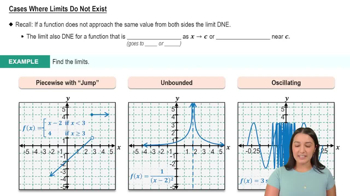
Cases Where Limits Do Not Exist

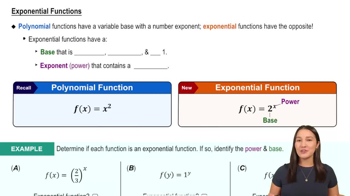
Exponential Functions

Exponential functions, such as f(x) = 1 - e^(-2x), are characterized by a constant base raised to a variable exponent. These functions exhibit rapid growth or decay, depending on the sign of the exponent. Understanding their properties, including their limits as x approaches infinity or negative infinity, is essential for analyzing their long-term behavior and applications in various fields.
Recommended video:
6:13
Exponential Functions

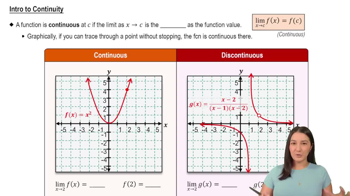
Continuous Functions

A function is continuous if there are no breaks, jumps, or holes in its graph. This property is important when evaluating limits, as continuous functions allow for the direct substitution of values. In the context of limits at infinity, continuity ensures that the limit can be determined by examining the function's behavior without encountering undefined points.
Recommended video:
05:34
Intro to Continuity