
Textbook Question
Approximating real numbers Use an appropriate Taylor series to find the first four nonzero terms of an infinite series that is equal to the following numbers. There is more than one way to choose the center of the series.
sin 20°

 Verified step by step guidance
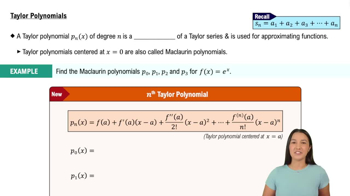
 07:00
07:00
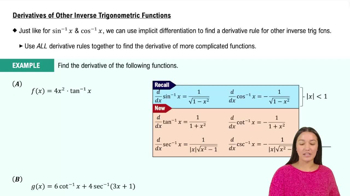 06:35
06:35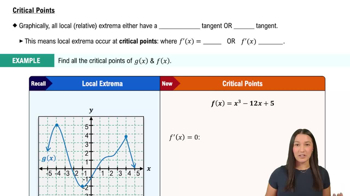 04:50
04:50Approximating real numbers Use an appropriate Taylor series to find the first four nonzero terms of an infinite series that is equal to the following numbers. There is more than one way to choose the center of the series.
sin 20°
Write out the first three terms of the Maclaurin series for the following functions.
ƒ(x) = (1 + x)^(1/3)"
Taylor series Write out the first three nonzero terms of the Taylor series for the following functions centered at the given point a. Then write the series using summation notation.
ƒ(x) = 1/(4 + x²), a = 0
Taylor series Write out the first three nonzero terms of the Taylor series for the following functions centered at the given point a. Then write the series using summation notation.
ƒ(x) = cos x, a = π/2
Convergence Write the remainder term Rₙ(x) for the Taylor series for the following functions centered at the given point a. Then show that lim ₙ → ∞ |Rₙ(x)| = 0, for all x in the given interval.
ƒ(x) = sinh x + cosh x, a = 0, - ∞ < x < ∞
Approximating ln 2 Consider the following three ways to approximate
ln 2.
a. Use the Taylor series for ln (1 + x) centered at 0 and evaluate it at x = 1 (convergence was asserted in Table 11.5). Write the resulting infinite series.