Ch. 11 - Power Series
Briggs - Calculus: Early Transcendentals 3rd Edition
Briggs3rd EditionCalculus: Early TranscendentalsISBN: 9780136847243Not the one you use?Change textbook
Chapter 11, Problem 11.R.60

Approximating real numbers Use an appropriate Taylor series to find the first four nonzero terms of an infinite series that is equal to the following numbers. There is more than one way to choose the center of the series.


sin 20°

Verified step by step guidance
1
Recognize that the problem asks for the first four nonzero terms of the Taylor series expansion of \( \sin 20^\circ \). Since Taylor series are typically expressed in radians, first convert \( 20^\circ \) to radians using \( x = 20^\circ \times \frac{\pi}{180} = \frac{\pi}{9} \).
Recall the Taylor series expansion of \( \sin x \) centered at 0 (Maclaurin series): \[ \sin x = \sum_{n=0}^\infty (-1)^n \frac{x^{2n+1}}{(2n+1)!} = x - \frac{x^3}{3!} + \frac{x^5}{5!} - \frac{x^7}{7!} + \cdots \]
Substitute \( x = \frac{\pi}{9} \) into the series to express \( \sin 20^\circ \) as: \[ \sin \left( \frac{\pi}{9} \right) = \frac{\pi}{9} - \frac{\left( \frac{\pi}{9} \right)^3}{3!} + \frac{\left( \frac{\pi}{9} \right)^5}{5!} - \frac{\left( \frac{\pi}{9} \right)^7}{7!} + \cdots \]
Identify the first four nonzero terms from this expansion, which correspond to the powers \( x^{1}, x^{3}, x^{5}, x^{7} \) with alternating signs as shown.
Optionally, consider other centers for the Taylor series (for example, around \( x = \frac{\pi}{6} \) or \( x = 0 \)) if it simplifies the computation, but the Maclaurin series is the most straightforward approach here.

Verified video answer for a similar problem:

This video solution was recommended by our tutors as helpful for the problem above.
Video duration:
2m
Was this helpful?

Key Concepts

Here are the essential concepts you must grasp in order to answer the question correctly.

Taylor Series Expansion

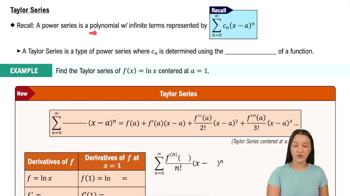
A Taylor series represents a function as an infinite sum of terms calculated from the derivatives at a single point (the center). It approximates functions near this center, allowing complex functions like sine to be expressed as polynomials. Choosing the center wisely can simplify calculations and improve convergence.
Recommended video:
08:42
Taylor Series

Trigonometric Function Approximation

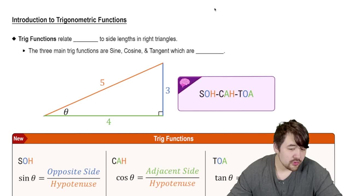
Functions like sine can be approximated using their Taylor series expansions around points such as 0 (Maclaurin series) or other angles. This approach helps estimate values like sin 20° by summing a finite number of terms, providing an accurate approximation without a calculator.
Recommended video:
6:04
Introduction to Trigonometric Functions

Choosing the Center of Expansion

Selecting the center (a) for the Taylor series affects the complexity and accuracy of the approximation. For sin 20°, centers like 0 or 30° can be chosen. Expanding around a point close to 20° often yields faster convergence and simpler computations for the first few terms.
Recommended video:
07:51
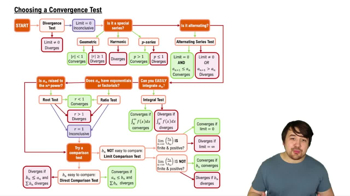
Choosing a Convergence Test