Ch. 11 - Power Series
Briggs - Calculus: Early Transcendentals 3rd Edition
Briggs3rd EditionCalculus: Early TranscendentalsISBN: 9780136847243Not the one you use?Change textbook
Chapter 11, Problem 11.R.47

Convergence Write the remainder term Rₙ(x) for the Taylor series for the following functions centered at the given point a. Then show that lim ₙ → ∞ |Rₙ(x)| = 0, for all x in the given interval.
ƒ(x) = sinh x + cosh x, a = 0, - ∞ < x < ∞

Verified step by step guidance
1
Identify the function and the center of the Taylor series expansion. Here, the function is \(f(x) = \sinh x + \cosh x\) and the center is \(a = 0\).
Recall the Taylor series remainder term in Lagrange form: \[R_n(x) = \frac{f^{(n+1)}(c)}{(n+1)!} (x - a)^{n+1}\] where \(c\) is some number between \(a\) and \(x\).
Find the \((n+1)\)-th derivative of \(f(x)\). Since \(f(x) = \sinh x + \cosh x\), note that the derivatives cycle in a predictable way. Compute \(f^{(n+1)}(x)\) explicitly or recognize the pattern.
Express the remainder term \(R_n(x)\) using the derivative found, substituting \(a=0\): \[R_n(x) = \frac{f^{(n+1)}(c)}{(n+1)!} x^{n+1}\] with \(c\) between \(0\) and \(x\).
To show that \(\lim_{n \to \infty} |R_n(x)| = 0\) for all real \(x\), analyze the growth of the numerator \(|f^{(n+1)}(c)|\) and the factorial in the denominator. Use the fact that factorial growth dominates exponential growth to conclude the limit is zero.

Verified video answer for a similar problem:

This video solution was recommended by our tutors as helpful for the problem above.
Video duration:
5m
Was this helpful?

Key Concepts

Here are the essential concepts you must grasp in order to answer the question correctly.

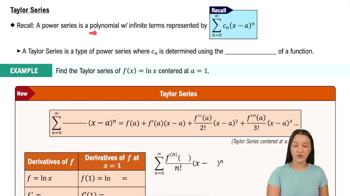
Taylor Series and Remainder Term

A Taylor series represents a function as an infinite sum of terms calculated from the derivatives at a single point. The remainder term Rₙ(x) measures the error between the function and its nth-degree Taylor polynomial. It is often expressed using the Lagrange form, involving the (n+1)th derivative evaluated at some point between a and x.
Recommended video:
08:42
Taylor Series

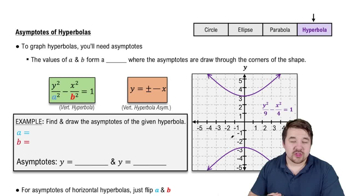
Hyperbolic Functions and Their Derivatives

The functions sinh x and cosh x are hyperbolic sine and cosine, respectively, with derivatives that cycle predictably: d/dx(sinh x) = cosh x and d/dx(cosh x) = sinh x. Understanding these derivatives helps in finding the Taylor series terms and the remainder for the combined function f(x) = sinh x + cosh x.
Recommended video:
5:50
Asymptotes of Hyperbolas

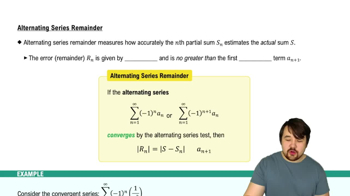
Limit of the Remainder Term and Convergence

To prove convergence of the Taylor series, we show that the remainder term Rₙ(x) approaches zero as n approaches infinity for all x in the interval. This involves bounding the remainder term and using properties of the function and its derivatives to demonstrate that the error vanishes, ensuring the series converges to the function.
Recommended video:
06:32
Alternating Series Remainder