Ch. 11 - Power Series
Briggs - Calculus: Early Transcendentals 3rd Edition
Briggs3rd EditionCalculus: Early TranscendentalsISBN: 9780136847243Not the one you use?Change textbook
Chapter 11, Problem 11.R.65a

Approximating ln 2 Consider the following three ways to approximate
ln 2.
a. Use the Taylor series for ln (1 + x) centered at 0 and evaluate it at x = 1 (convergence was asserted in Table 11.5). Write the resulting infinite series.

Verified step by step guidance
1
Recall the Taylor series expansion for \( \ln(1 + x) \) centered at 0 (Maclaurin series), which is given by the infinite sum: \[ \ln(1 + x) = \sum_{n=1}^{\infty} (-1)^{n+1} \frac{x^n}{n} \quad \text{for} \quad -1 < x \leq 1. \]
To approximate \( \ln 2 \), substitute \( x = 1 \) into the series because \( \ln 2 = \ln(1 + 1) \). This gives: \[ \ln 2 = \sum_{n=1}^{\infty} (-1)^{n+1} \frac{1^n}{n} = \sum_{n=1}^{\infty} (-1)^{n+1} \frac{1}{n}. \]
Write out the first few terms explicitly to see the pattern: \[ \ln 2 = 1 - \frac{1}{2} + \frac{1}{3} - \frac{1}{4} + \frac{1}{5} - \cdots \]
Note that this is an alternating series where the terms decrease in magnitude and approach zero, which ensures convergence to \( \ln 2 \).
This infinite series representation is the exact Taylor series expression for \( \ln 2 \) centered at 0, and it can be used to approximate \( \ln 2 \) by summing a finite number of terms.

Verified video answer for a similar problem:

This video solution was recommended by our tutors as helpful for the problem above.
Video duration:
2m
Was this helpful?

Key Concepts

Here are the essential concepts you must grasp in order to answer the question correctly.

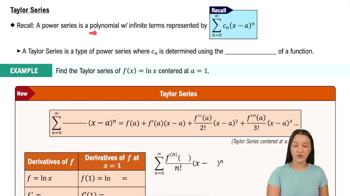
Taylor Series Expansion

A Taylor series represents a function as an infinite sum of terms calculated from the derivatives at a single point. For ln(1 + x) centered at 0, the series expresses ln(1 + x) as a power series in x, allowing approximation by partial sums. This method is fundamental for approximating functions near the center point.
Recommended video:
08:42
Taylor Series

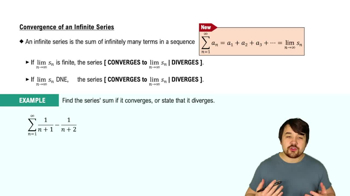
Convergence of Infinite Series

Convergence refers to whether the infinite sum of a series approaches a finite value. For the Taylor series of ln(1 + x) at x = 1, convergence ensures the series sum equals ln(2). Understanding the interval and conditions of convergence is essential to justify using the series for approximation.
Recommended video:
06:52
Convergence of an Infinite Series

Natural Logarithm Function Properties

The natural logarithm ln(x) is the inverse of the exponential function e^x and is defined for x > 0. Its behavior near 1 is smooth and differentiable, making it suitable for Taylor expansion. Recognizing properties of ln(1 + x) helps in setting up and interpreting the series approximation.
Recommended video:
06:21
Properties of Functions