Ch. 11 - Power Series
Briggs - Calculus: Early Transcendentals 3rd Edition
Briggs3rd EditionCalculus: Early TranscendentalsISBN: 9780136847243Not the one you use?Change textbook
Chapter 11, Problem 11.R.46

Binomial series Write out the first three terms of the Maclaurin series for the following functions.
ƒ(x) = (1 + 2x)^(-5)

Verified step by step guidance
1
Recall that the Maclaurin series is a special case of the Taylor series expanded at \(x = 0\). For a function \(f(x)\), the Maclaurin series is given by \(f(x) = \sum_{n=0}^{\infty} \frac{f^{(n)}(0)}{n!} x^n\).
Recognize that the function \(f(x) = (1 + 2x)^{-5}\) can be expanded using the binomial series formula for negative integer exponents: \( (1 + u)^k = \sum_{n=0}^{\infty} \binom{k}{n} u^n \), where \(k = -5\) and \(u = 2x\).
Write the general term of the binomial series for this function as \( \binom{-5}{n} (2x)^n \), where the binomial coefficient for negative integers is defined as \( \binom{k}{n} = \frac{k (k-1) (k-2) \cdots (k - n + 1)}{n!} \).
Calculate the first three terms by substituting \(n = 0, 1, 2\) into the general term: - For \(n=0\): \(\binom{-5}{0} (2x)^0\) - For \(n=1\): \(\binom{-5}{1} (2x)^1\) - For \(n=2\): \(\binom{-5}{2} (2x)^2\).
Simplify each term by evaluating the binomial coefficients and powers of \$2x$ to write out the first three terms of the Maclaurin series explicitly.

Verified video answer for a similar problem:

This video solution was recommended by our tutors as helpful for the problem above.
Video duration:
3m
Was this helpful?

Key Concepts

Here are the essential concepts you must grasp in order to answer the question correctly.

Maclaurin Series

The Maclaurin series is a special case of the Taylor series expanded at x = 0. It represents a function as an infinite sum of terms calculated from the derivatives of the function at zero. Writing out the first few terms involves evaluating the function and its derivatives at zero and expressing them as powers of x.
Recommended video:
08:26
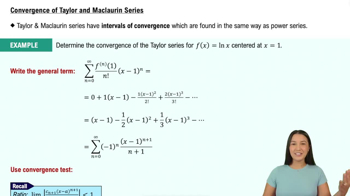
Convergence of Taylor & Maclaurin Series

Binomial Series Expansion

The binomial series generalizes the binomial theorem to any real exponent, allowing expansion of expressions like (1 + x)^n where n can be negative or fractional. It expresses the function as an infinite sum involving binomial coefficients, which are calculated using combinations or the generalized formula for non-integer powers.
Recommended video:
06:00
Geometric Series

Calculating Binomial Coefficients for Negative Powers

For negative integer exponents, binomial coefficients are computed using the formula involving factorials or the generalized binomial coefficient definition. These coefficients determine the sign and magnitude of each term in the series, crucial for correctly expanding functions like (1 + 2x)^(-5).
Recommended video:
04:09
The Power Rule: Negative & Rational Exponents