
Ch. 11 - Power Series
Briggs - Calculus: Early Transcendentals 3rd Edition
Briggs3rd EditionCalculus: Early TranscendentalsISBN: 9780136847243Not the one you use?Change textbook
Chapter 11, Problem 11.2.78

Inverse sine Given the power series
1/√(1 − x²) = 1 + (1/2)x² + (1 ⋅ 3)/(2 ⋅ 4) x⁴ + (1 ⋅ 3 ⋅ 5)/(2 ⋅ 4 ⋅ 6) x⁶ +⋯
for −1<x<1, find the power series for f(x) = sin ⁻¹ x centered at 0.

Verified step by step guidance
1
Recall that the function \( f(x) = \sin^{-1} x \) is the integral of its derivative. Since \( \frac{d}{dx} \sin^{-1} x = \frac{1}{\sqrt{1 - x^2}} \), we can use the given power series for \( \frac{1}{\sqrt{1 - x^2}} \) to find the series for \( \sin^{-1} x \).
Write the given power series explicitly as: \[ \frac{1}{\sqrt{1 - x^2}} = 1 + \frac{1}{2} x^2 + \frac{1 \cdot 3}{2 \cdot 4} x^4 + \frac{1 \cdot 3 \cdot 5}{2 \cdot 4 \cdot 6} x^6 + \cdots \]
Integrate the series term-by-term with respect to \( x \) from 0 to \( x \) to find \( \sin^{-1} x \): \[ \sin^{-1} x = \int_0^x \frac{1}{\sqrt{1 - t^2}} dt = \int_0^x \left(1 + \frac{1}{2} t^2 + \frac{1 \cdot 3}{2 \cdot 4} t^4 + \frac{1 \cdot 3 \cdot 5}{2 \cdot 4 \cdot 6} t^6 + \cdots \right) dt \]
Integrate each term individually: - The integral of 1 with respect to \( t \) is \( t \). - The integral of \( t^2 \) is \( \frac{t^3}{3} \). - The integral of \( t^4 \) is \( \frac{t^5}{5} \), and so on. So the series becomes: \[ \sin^{-1} x = x + \frac{1}{2} \cdot \frac{x^3}{3} + \frac{1 \cdot 3}{2 \cdot 4} \cdot \frac{x^5}{5} + \frac{1 \cdot 3 \cdot 5}{2 \cdot 4 \cdot 6} \cdot \frac{x^7}{7} + \cdots \]
Simplify the coefficients to write the power series for \( \sin^{-1} x \) centered at 0. This series converges for \( -1 < x < 1 \) and represents the inverse sine function as a power series.

Verified video answer for a similar problem:

This video solution was recommended by our tutors as helpful for the problem above.
Video duration:
5m
Was this helpful?

Key Concepts

Here are the essential concepts you must grasp in order to answer the question correctly.

Power Series Representation

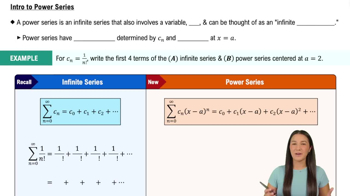
A power series expresses a function as an infinite sum of terms involving powers of the variable, typically centered at a point (here, 0). It allows complex functions to be approximated by polynomials within a certain interval of convergence, facilitating analysis and computation.
Recommended video:
05:58
Intro to Power Series

Relationship Between a Function and Its Derivative

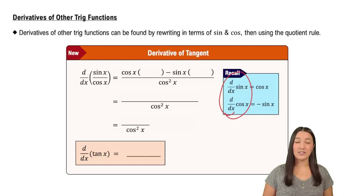
The derivative of the inverse sine function, sin⁻¹(x), is 1/√(1 − x²). Knowing the power series for the derivative enables us to find the power series for the original function by integrating term-by-term within the interval of convergence.
Recommended video:
06:30
Derivatives of Other Trig Functions

Term-by-Term Integration of Power Series

Integrating a power series term-by-term involves integrating each term individually, which is valid within the radius of convergence. This process is used to find the power series of a function when the series for its derivative is known, as in finding sin⁻¹(x) from 1/√(1 − x²).
Recommended video:
05:58
Intro to Power Series
Related Practice
Textbook Question

L'Hôpital's Rule by Taylor series Suppose f and g have Taylor series about the point a.

a. If f(a) = g(a) = 0 and g′(a) ≠ 0, evaluate lim ₓ→ₐ f(x)/g(x) by expanding f and g in their Taylor series. Show that the result is consistent withl’Hôpital’s Rule.

b. If f(a) = g(a) =f′(a) = g′(a) = 0 and g′′(a) ≠ 0, evaluate lim ₓ→ₐ f(x)/g(x) by expanding f and g in their Taylor series. Show that the result is consistent with two applications of 1'Hôpital's Rule.

Textbook Question

 A useful substitution Replace x with x−1 in the series ln (1+x) = ∑ₖ₌₁∞ ((−1)ᵏ⁺¹ xᵏ)/k to obtain a power series for ln x centered at x = 1. What is the interval of convergence for the new power series?

1
views
Textbook Question

{Use of Tech} Maximum error Use the remainder term to find a bound on the error in the following approximations on the given interval. Error bounds are not unique.


tan x ≈ x on [−π/6, π/6]

Textbook Question

Exponential function In Section 11.3, we show that the power series for the exponential function centered at 0 is


eˣ = ∑ₖ₌₀∞ (xᵏ)/k!, for −∞ < x < ∞


Use the methods of this section to find the power series centered at 0 for the following functions. Give the interval of convergence for the resulting series.


f(x) = e⁻³ˣ

1
views
Textbook Question

Radius and interval of convergence Determine the radius and interval of convergence of the following power series.


∑ₖ₌₁∞ (3x + 2)ᵏ/k

1
views
Textbook Question

Limits Evaluate the following limits using Taylor series.

lim ₓ→₁ (x 1)/(ln x)