
Ch. 11 - Power Series
Briggs - Calculus: Early Transcendentals 3rd Edition
Briggs3rd EditionCalculus: Early TranscendentalsISBN: 9780136847243Not the one you use?Change textbook
Chapter 11, Problem 11.4.83

L'Hôpital's Rule by Taylor series Suppose f and g have Taylor series about the point a.
a. If f(a) = g(a) = 0 and g′(a) ≠ 0, evaluate lim ₓ→ₐ f(x)/g(x) by expanding f and g in their Taylor series. Show that the result is consistent withl’Hôpital’s Rule.
b. If f(a) = g(a) =f′(a) = g′(a) = 0 and g′′(a) ≠ 0, evaluate lim ₓ→ₐ f(x)/g(x) by expanding f and g in their Taylor series. Show that the result is consistent with two applications of 1'Hôpital's Rule.

Verified step by step guidance
1
Step 1: Recall the Taylor series expansions of functions \(f\) and \(g\) about the point \(a\). For a function \(h\), the expansion is: \[ \displaystyle h(x) = h(a) + h'(a)(x - a) + \frac{h''(a)}{2!}(x - a)^2 + \cdots \] We will use this to expand both \(f(x)\) and \(g(x)\).
Step 2: For part (a), since \(f(a) = g(a) = 0\) and \(g'(a) \neq 0\), write the expansions: \[ \begin{aligned} f(x) &= f(a) + f'(a)(x - a) + \cdots = f'(a)(x - a) + \cdots \\ g(x) &= g(a) + g'(a)(x - a) + \cdots = g'(a)(x - a) + \cdots \end{aligned} \] Ignore higher order terms as \(x \to a\).
Step 3: Form the ratio \(\frac{f(x)}{g(x)}\) near \(x = a\): \[ \frac{f(x)}{g(x)} \approx \frac{f'(a)(x - a)}{g'(a)(x - a)} = \frac{f'(a)}{g'(a)} \] This shows the limit is \(\lim_{x \to a} \frac{f(x)}{g(x)} = \frac{f'(a)}{g'(a)}\), consistent with L'Hôpital's Rule applied once.
Step 4: For part (b), given \(f(a) = g(a) = f'(a) = g'(a) = 0\) and \(g''(a) \neq 0\), write the expansions including second derivatives: \[ \begin{aligned} f(x) &= f(a) + f'(a)(x - a) + \frac{f''(a)}{2}(x - a)^2 + \cdots = \frac{f''(a)}{2}(x - a)^2 + \cdots \\ g(x) &= g(a) + g'(a)(x - a) + \frac{g''(a)}{2}(x - a)^2 + \cdots = \frac{g''(a)}{2}(x - a)^2 + \cdots \end{aligned} \]
Step 5: Form the ratio near \(x = a\): \[ \frac{f(x)}{g(x)} \approx \frac{\frac{f''(a)}{2}(x - a)^2}{\frac{g''(a)}{2}(x - a)^2} = \frac{f''(a)}{g''(a)} \] This matches the result of applying L'Hôpital's Rule twice, since the first derivatives vanish and the second derivatives determine the limit.

Verified video answer for a similar problem:

This video solution was recommended by our tutors as helpful for the problem above.
Video duration:
3m
Was this helpful?

Key Concepts

Here are the essential concepts you must grasp in order to answer the question correctly.

Taylor Series Expansion

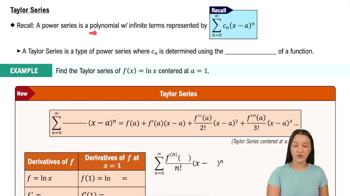
A Taylor series represents a function as an infinite sum of terms calculated from the derivatives at a single point. It approximates functions near that point, allowing us to express f(x) and g(x) as polynomials around a. This expansion is crucial for analyzing limits by comparing the leading terms of f and g.
Recommended video:
08:42
Taylor Series

L'Hôpital's Rule

L'Hôpital's Rule helps evaluate limits of indeterminate forms like 0/0 by differentiating numerator and denominator. If f(a) = g(a) = 0 and g'(a) ≠ 0, the limit of f(x)/g(x) as x approaches a equals f'(a)/g'(a). This rule can be applied repeatedly if higher-order derivatives vanish.
Recommended video:

Relationship Between Taylor Series and L'Hôpital's Rule

By expanding f and g into Taylor series, the leading nonzero terms determine the limit of f(x)/g(x). This approach shows that the ratio of the first nonzero derivatives matches the result from L'Hôpital's Rule, providing a series-based justification for the rule and its repeated application.
Recommended video:
08:42
Taylor Series