
Ch. 11 - Power Series
Briggs - Calculus: Early Transcendentals 3rd Edition
Briggs3rd EditionCalculus: Early TranscendentalsISBN: 9780136847243Not the one you use?Change textbook
Chapter 11, Problem 11.2.73

Exponential function In Section 11.3, we show that the power series for the exponential function centered at 0 is


eˣ = ∑ₖ₌₀∞ (xᵏ)/k!, for −∞ < x < ∞


Use the methods of this section to find the power series centered at 0 for the following functions. Give the interval of convergence for the resulting series.


f(x) = e⁻³ˣ

Verified step by step guidance
1
Recall the power series expansion for the exponential function centered at 0: \[e^{x} = \sum_{k=0}^{\infty} \frac{x^{k}}{k!}\] which converges for all real numbers \[x\] (i.e., the interval of convergence is \[(-\infty, \infty)\]).
To find the power series for \[f(x) = e^{-3x}\], substitute \[-3x\] in place of \[x\] in the original series. This gives: \[e^{-3x} = \sum_{k=0}^{\infty} \frac{(-3x)^{k}}{k!}\].
Rewrite the terms inside the summation to separate powers of \[x\] and constants: \[e^{-3x} = \sum_{k=0}^{\infty} \frac{(-3)^{k} x^{k}}{k!}\].
Since the original exponential series converges for all real numbers, replacing \[x\] by \[-3x\] does not change the radius of convergence. Therefore, the interval of convergence remains \[(-\infty, \infty)\].
Summarize the power series for \[f(x)\] as \[f(x) = \sum_{k=0}^{\infty} \frac{(-3)^{k}}{k!} x^{k}\] with interval of convergence \[(-\infty, \infty)\].

Verified video answer for a similar problem:

This video solution was recommended by our tutors as helpful for the problem above.
Video duration:
2m
Was this helpful?

Key Concepts

Here are the essential concepts you must grasp in order to answer the question correctly.

Power Series Representation of Functions

A power series expresses a function as an infinite sum of terms involving powers of the variable, typically centered at a point (here, 0). For example, the exponential function eˣ can be written as ∑ₖ₌₀∞ (xᵏ)/k!. Understanding this allows us to represent more complex functions by manipulating known series.
Recommended video:
07:32
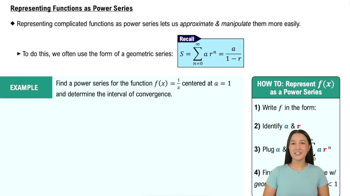
Representing Functions as Power Series

Substitution in Power Series

To find the power series of a function like f(x) = e⁻³ˣ, we substitute the inner expression (−3x) into the known series for eˣ. This means replacing x by −3x in the series, resulting in ∑ₖ₌₀∞ ((−3x)ᵏ)/k!. This technique helps generate new series from existing ones.
Recommended video:
05:58
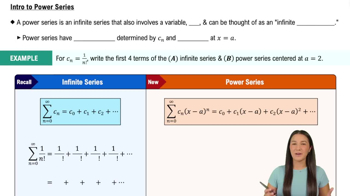
Intro to Power Series

Interval of Convergence

The interval of convergence is the set of x-values for which the power series converges to the function. For the exponential series, the interval is all real numbers (−∞, ∞). After substitution, it is important to verify if the interval changes, ensuring the series accurately represents the function within that domain.
Recommended video:
08:44
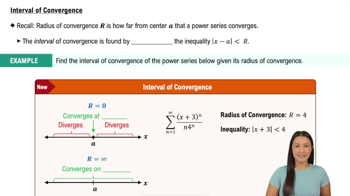
Interval of Convergence