Ch. 11 - Power Series
Briggs - Calculus: Early Transcendentals 3rd Edition
Briggs3rd EditionCalculus: Early TranscendentalsISBN: 9780136847243Not the one you use?Change textbook
Chapter 11, Problem 11.2.66

 A useful substitution Replace x with x−1 in the series ln (1+x) = ∑ₖ₌₁∞ ((−1)ᵏ⁺¹ xᵏ)/k to obtain a power series for ln x centered at x = 1. What is the interval of convergence for the new power series?

Verified step by step guidance
1
Start with the given power series for \( \ln(1+x) \): \[ \ln(1+x) = \sum_{k=1}^{\infty} (-1)^{k+1} \frac{x^k}{k} \] which is centered at \( x=0 \) and converges for \( -1 < x \leq 1 \).
Make the substitution \( x \to x - 1 \) to express \( \ln x \) in terms of \( x - 1 \): \[ \ln x = \ln(1 + (x-1)) = \sum_{k=1}^{\infty} (-1)^{k+1} \frac{(x-1)^k}{k} \] This gives a power series for \( \ln x \) centered at \( x = 1 \).
Determine the interval of convergence for the new series by considering the original interval \( -1 < x \leq 1 \) for \( \ln(1+x) \). Since the substitution is \( x = t + 1 \), the original variable \( x \) in the series corresponds to \( t = x - 1 \). The original interval \( -1 < x \leq 1 \) becomes \( -1 < t \leq 1 \), so for \( t = x - 1 \), the interval is \( -1 < x - 1 \leq 1 \).
Solve the inequalities for \( x \): \[ -1 < x - 1 \leq 1 \implies 0 < x \leq 2 \] This means the power series for \( \ln x \) centered at \( x=1 \) converges for \( x \) in the interval \( (0, 2] \).
Check the endpoints for convergence: - At \( x = 0 \), the series does not converge because \( \ln x \) is not defined at zero. - At \( x = 2 \), substitute into the series and verify convergence using the alternating series test or other convergence tests. Thus, the interval of convergence for the new power series is \( (0, 2] \).

Verified video answer for a similar problem:

This video solution was recommended by our tutors as helpful for the problem above.
Video duration:
3m
Was this helpful?

Key Concepts

Here are the essential concepts you must grasp in order to answer the question correctly.

Power Series and Centering

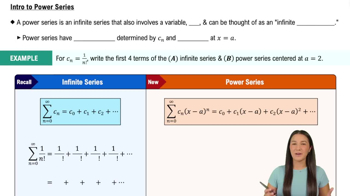
A power series is an infinite sum of terms involving powers of (x - a), where 'a' is the center. Changing variables or substituting x with (x - 1) shifts the center of the series, allowing us to express functions like ln(x) as a series centered at x = 1 instead of 0.
Recommended video:
05:58
Intro to Power Series

Interval of Convergence

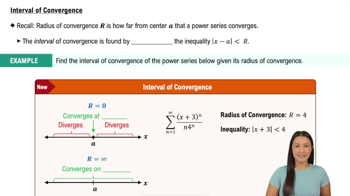
The interval of convergence is the set of x-values for which a power series converges. It depends on the radius of convergence and the center. After substitution, the interval shifts accordingly, and determining it involves analyzing the original series' convergence and the effect of the substitution.
Recommended video:
08:44
Interval of Convergence

Substitution in Power Series

Substitution involves replacing the variable in a known power series with an expression like (x - 1). This transforms the series to represent a related function centered at a new point. Careful substitution helps derive new series expansions and their convergence properties.
Recommended video:
05:58
Intro to Power Series