Ch. 11 - Power Series
Briggs - Calculus: Early Transcendentals 3rd Edition
Briggs3rd EditionCalculus: Early TranscendentalsISBN: 9780136847243Not the one you use?Change textbook
Chapter 11, Problem 11.1.62

{Use of Tech} Number of terms What is the minimum order of the Taylor polynomial required to approximate the following quantities with an absolute error no greater than 10⁻³ ? (The answer depends on your choice of a center.)
ln 0.85

Verified step by step guidance
1
Identify the function to approximate: here, it is \( f(x) = \ln(x) \). We want to approximate \( \ln(0.85) \) using a Taylor polynomial centered at some point \( a \).
Choose a center \( a \) close to 0.85 to ensure faster convergence and smaller error. A common choice is \( a = 1 \) because \( \ln(1) = 0 \) and derivatives of \( \ln(x) \) at 1 are easy to compute.
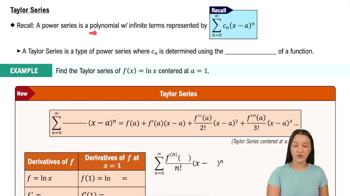
Write the Taylor series expansion of \( \ln(x) \) about \( a = 1 \): \[ \ln(x) = \ln(1) + \sum_{n=1}^{\infty} \frac{f^{(n)}(1)}{n!} (x - 1)^n \] where \( f^{(n)}(x) \) denotes the \( n \)-th derivative of \( \ln(x) \).
Determine the general form of the \( n \)-th derivative of \( \ln(x) \) at \( x=1 \) and write the Taylor polynomial of order \( N \) as: \[ P_N(x) = \sum_{n=1}^N \frac{(-1)^{n-1} (n-1)!}{n!} (x - 1)^n = \sum_{n=1}^N (-1)^{n-1} \frac{(x-1)^n}{n} \] (since the derivatives of \( \ln(x) \) at 1 follow a known pattern).
Use the Lagrange remainder formula to bound the absolute error: \[ |R_{N}(x)| = \left| \frac{f^{(N+1)}(c)}{(N+1)!} (x - 1)^{N+1} \right| \leq 10^{-3} \] where \( c \) is some number between \( x = 0.85 \) and \( a = 1 \). Find the smallest \( N \) such that this inequality holds.

Verified video answer for a similar problem:

This video solution was recommended by our tutors as helpful for the problem above.
Video duration:
4m
Was this helpful?

Key Concepts

Here are the essential concepts you must grasp in order to answer the question correctly.

Taylor Polynomial Approximation

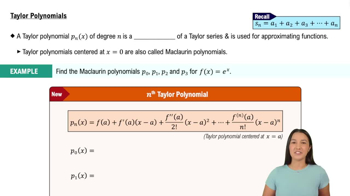
A Taylor polynomial approximates a function near a chosen center point using a finite sum of derivatives at that point. The degree (order) of the polynomial determines the accuracy of the approximation, with higher orders generally yielding better precision within a certain interval.
Recommended video:
07:00
Taylor Polynomials

Error Bound for Taylor Polynomials

The error bound estimates the difference between the actual function value and its Taylor polynomial approximation. It is often expressed using the remainder term, which depends on the next derivative and the distance from the center, helping to determine the minimum polynomial order needed for a desired accuracy.
Recommended video:
07:00
Taylor Polynomials

Choice of Center in Taylor Series

The center (or expansion point) of a Taylor series affects convergence and error size. Choosing a center close to the point of evaluation reduces the distance in the remainder term, often lowering the required polynomial order to achieve a specific error tolerance.
Recommended video:
08:42
Taylor Series