A limit by Taylor series Use Taylor series to evaluate lim ₓ→₀ ((sin x)/x)¹/ˣ²
Ch. 11 - Power Series
Briggs3rd EditionCalculus: Early TranscendentalsISBN: 9780136847243Not the one you use?Change textbook
Chapter 11, Problem 11.3.79
{Use of Tech} Approximating powers Compute the coefficients for the Taylor series for the following functions about the given point a, and then use the first four terms of the series to approximate the given number.
f(x) = ∜x with a=16; approximate ∜13.
Verified step by step guidance1
Identify the function and the point about which to expand: here, the function is \(f(x) = \sqrt[4]{x} = x^{\frac{1}{4}}\), and the expansion point is \(a = 16\).
Compute the derivatives of \(f(x)\) up to the third derivative, since we want the first four terms of the Taylor series (which includes the function value and the first three derivatives). Use the power rule for derivatives: for \(f(x) = x^{n}\), \(f^{(k)}(x) = n (n-1) \cdots (n-k+1) x^{n-k}\).
Evaluate each derivative at the point \(x = 16\). This means calculating \(f(16)\), \(f'(16)\), \(f''(16)\), and \(f'''(16)\).
Write the Taylor series expansion of \(f(x)\) about \(a=16\) up to the third derivative term using the formula:
\[
T_3(x) = f(16) + f'(16)(x-16) + \frac{f''(16)}{2!}(x-16)^2 + \frac{f'''(16)}{3!}(x-16)^3
\]
Substitute \(x = 13\) into the Taylor polynomial \(T_3(x)\) to approximate \(\sqrt[4]{13}\). This gives an approximation using the first four terms of the Taylor series.

Verified video answer for a similar problem:
This video solution was recommended by our tutors as helpful for the problem above.
Video duration:
5mWas this helpful?
Key Concepts
Here are the essential concepts you must grasp in order to answer the question correctly.
Taylor Series Expansion
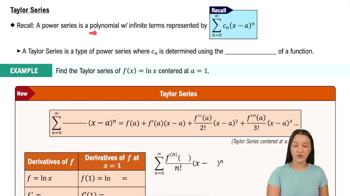
The Taylor series represents a function as an infinite sum of terms calculated from the derivatives of the function at a specific point a. It approximates the function near a by using polynomial terms, making it easier to estimate values close to a.
Recommended video:
Taylor Series
Derivatives of Root Functions
To find the Taylor series coefficients, you need to compute derivatives of the function f(x) = ∜x (the fourth root of x). Understanding how to differentiate root functions and simplify the results is essential for accurate coefficient calculation.
Recommended video:
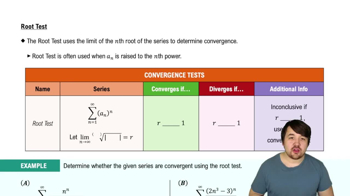
Root Test
Polynomial Approximation and Evaluation
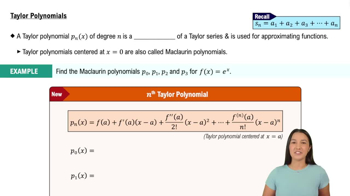
Using the first four terms of the Taylor series creates a polynomial that approximates the function near the point a. Evaluating this polynomial at the desired value (x=13) provides an approximate value for ∜13, demonstrating practical use of series expansions.
Recommended video:
Taylor Polynomials
Related Practice
Textbook Question
1
views
Textbook Question
Limits Evaluate the following limits using Taylor series.
lim ₓ→₀ (eˣ − 1)/x
Textbook Question
Taylor polynomials Find the nth-order Taylor polynomial for the following functions centered at the given point a.
ƒ(x) = cosh x, n = 3, a = ln 2
1
views
Textbook Question
A useful substitution Replace x with x−1 in the series ln (1+x) = ∑ₖ₌₁∞ ((−1)ᵏ⁺¹ xᵏ)/k to obtain a power series for ln x centered at x = 1. What is the interval of convergence for the new power series?
1
views
Textbook Question
Limits Evaluate the following limits using Taylor series.
lim ₓ→₁ (x 1)/(ln x)
Textbook Question
{Use of Tech} Number of terms What is the minimum order of the Taylor polynomial required to approximate the following quantities with an absolute error no greater than 10⁻³ ? (The answer depends on your choice of a center.)
ln 0.85