
Ch. 10 - Sequences and Infinite Series
Briggs - Calculus: Early Transcendentals 3rd Edition
Briggs3rd EditionCalculus: Early TranscendentalsISBN: 9780136847243Not the one you use?Change textbook
Chapter 10, Problem 10.R.7

Give an example (if possible) of a sequence {aₖ} that converges, while the series ∑ (from k = 1 to ∞) aₖ diverges.

Verified step by step guidance
1
Recall the definitions: A sequence \( \{a_k\} \) converges if \( \lim_{k \to \infty} a_k = L \) for some finite number \( L \). A series \( \sum_{k=1}^\infty a_k \) converges if the sequence of partial sums \( S_n = \sum_{k=1}^n a_k \) converges to a finite limit.
Note that if the series \( \sum a_k \) converges, then the terms \( a_k \) must approach zero. However, the converse is not true: \( a_k \to 0 \) does not guarantee that \( \sum a_k \) converges.
To find an example where \( \{a_k\} \) converges but \( \sum a_k \) diverges, consider the sequence \( a_k = \frac{1}{k} \). This sequence converges to zero as \( k \to \infty \).
Examine the series \( \sum_{k=1}^\infty \frac{1}{k} \), known as the harmonic series. It is a classic example of a divergent series despite its terms tending to zero.
Thus, the sequence \( a_k = \frac{1}{k} \) converges to zero, but the series \( \sum_{k=1}^\infty a_k = \sum_{k=1}^\infty \frac{1}{k} \) diverges.

Verified video answer for a similar problem:

This video solution was recommended by our tutors as helpful for the problem above.
Video duration:
2m
Was this helpful?

Key Concepts

Here are the essential concepts you must grasp in order to answer the question correctly.

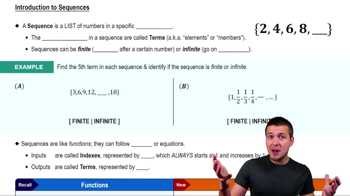
Convergence of a Sequence

A sequence {aₖ} converges if its terms approach a specific finite limit as k approaches infinity. This means for large k, the terms get arbitrarily close to that limit. For example, the sequence aₖ = 1/k converges to 0.
Recommended video:
Guided course
8:22
Introduction to Sequences

Divergence of a Series

A series ∑ aₖ diverges if the sum of its terms does not approach a finite limit as the number of terms grows. Even if the terms aₖ approach zero, the series can still diverge, such as the harmonic series ∑ 1/k.
Recommended video:
06:00
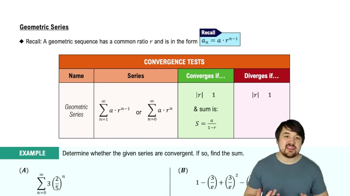
Geometric Series

Relationship Between Sequence and Series Convergence

While a sequence {aₖ} may converge to zero, the corresponding series ∑ aₖ might diverge. This distinction is crucial because term-wise convergence to zero is necessary but not sufficient for series convergence.
Recommended video:
06:52
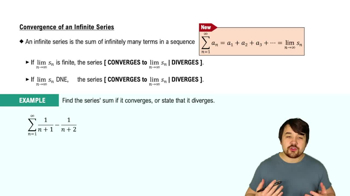
Convergence of an Infinite Series
Related Practice
Textbook Question

88–89. Binary numbers

Humans use the ten digits 0 through 9 to form base-10 or decimal numbers, whereas computers calculate and store numbers internally as binary numbers—numbers consisting entirely of 0’s and 1’s. For this exercise, we consider binary numbers that have the form 0.b₁b₂b₃⋯, where each of the digits b₁, b₂, b₃, ⋯ is either 0 or 1. The base-10 representation of the binary number 0.b₁b₂b₃⋯ is the infinite series

b₁ / 2¹ + b₂ / 2² + b₃ / 2³ + ⋯


89. Computers can store only a finite number of digits and therefore numbers with nonterminating digits must be rounded or truncated before they can be used and stored by a computer.


a. Find the base-10 representation of the binary number 0.001̅1.

1
views
Textbook Question

12–24. Limits of sequences Evaluate the limit of the sequence or state that it does not exist.

aₙ = ((3n² + 2n + 1) · sin(n)) / (4n³ + n) (Hint: Use the Squeeze Theorem.)

1
views
Textbook Question

12–24. Limits of sequences Evaluate the limit of the sequence or state that it does not exist.

aₙ = (–1)ⁿ / 0.9ⁿ

1
views
Textbook Question

27–37. Evaluating series Evaluate the following infinite series or state that the series diverges.

∑ (from k = 1 to ∞)2ᵏ / 3ᵏ⁺²

Textbook Question

87. Explain why or why not

Determine whether the following statements are true and give an explanation or counterexample.


a. If ∑ (k = 1 to ∞) aₖ converges, then ∑ (k = 10 to ∞) aₖ converges.

1
views
Textbook Question

Express 0.314141414… as a ratio of two integers.