
Ch. 10 - Sequences and Infinite Series
Briggs - Calculus: Early Transcendentals 3rd Edition
Briggs3rd EditionCalculus: Early TranscendentalsISBN: 9780136847243Not the one you use?Change textbook
Chapter 10, Problem 10.3.87a

87. Explain why or why not
Determine whether the following statements are true and give an explanation or counterexample.


a. If ∑ (k = 1 to ∞) aₖ converges, then ∑ (k = 10 to ∞) aₖ converges.

Verified step by step guidance
1
Understand the problem: We are asked to determine if the convergence of the infinite series \(\sum_{k=1}^{\infty} a_k\) implies the convergence of the series \(\sum_{k=10}^{\infty} a_k\).
Recall the definition of convergence for infinite series: A series \(\sum_{k=m}^{\infty} a_k\) converges if the sequence of partial sums \(S_n = \sum_{k=m}^{n} a_k\) approaches a finite limit as \(n \to \infty\).
Consider the relationship between the two series: The series starting at \(k=10\) is essentially the tail of the series starting at \(k=1\). Specifically, \(\sum_{k=1}^{\infty} a_k = \sum_{k=1}^{9} a_k + \sum_{k=10}^{\infty} a_k\).
Since the sum of the first 9 terms, \(\sum_{k=1}^{9} a_k\), is a finite number, subtracting it from the convergent series \(\sum_{k=1}^{\infty} a_k\) leaves the tail \(\sum_{k=10}^{\infty} a_k\), which must also converge.
Therefore, the convergence of \(\sum_{k=1}^{\infty} a_k\) guarantees the convergence of \(\sum_{k=10}^{\infty} a_k\) because removing a finite number of terms from the start of a convergent series does not affect its convergence.

Verified video answer for a similar problem:

This video solution was recommended by our tutors as helpful for the problem above.
Video duration:
2m
Was this helpful?

Key Concepts

Here are the essential concepts you must grasp in order to answer the question correctly.

Infinite Series and Convergence

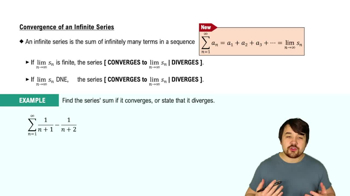
An infinite series is the sum of infinitely many terms. A series converges if the sequence of its partial sums approaches a finite limit. Understanding convergence is essential to determine whether changing the starting index affects the sum's behavior.
Recommended video:
06:52
Convergence of an Infinite Series

Effect of Finite Number of Terms on Convergence

Adding or removing a finite number of terms from an infinite series does not affect its convergence. Since convergence depends on the tail behavior of the series, starting the sum at k=10 instead of k=1 preserves convergence if the original series converges.
Recommended video:
05:44
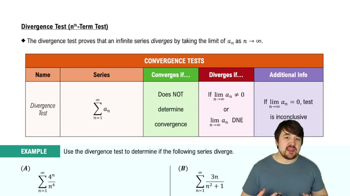
Divergence Test (nth Term Test)

Partial Sums and Tail of a Series

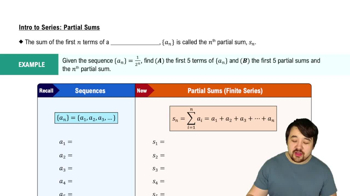
Partial sums are sums of the first n terms of a series. The tail of a series refers to the sum from some index onward. Convergence depends on the tail's limit, so analyzing the tail from k=10 onward helps determine if the series remains convergent.
Recommended video:
06:45
Intro to Series: Partial Sums
Related Practice
Textbook Question

88–89. Binary numbers

Humans use the ten digits 0 through 9 to form base-10 or decimal numbers, whereas computers calculate and store numbers internally as binary numbers—numbers consisting entirely of 0’s and 1’s. For this exercise, we consider binary numbers that have the form 0.b₁b₂b₃⋯, where each of the digits b₁, b₂, b₃, ⋯ is either 0 or 1. The base-10 representation of the binary number 0.b₁b₂b₃⋯ is the infinite series

b₁ / 2¹ + b₂ / 2² + b₃ / 2³ + ⋯


89. Computers can store only a finite number of digits and therefore numbers with nonterminating digits must be rounded or truncated before they can be used and stored by a computer.


a. Find the base-10 representation of the binary number 0.001̅1.

1
views
Textbook Question

Explain why or why not

Determine whether the following statements are true and give an explanation or counterexample.

a.If limₙ→∞aₙ = 1 and limₙ→∞bₙ = 3, then limₙ→∞(bₙ / aₙ) = 3.

1
views
Textbook Question

Express 0.314141414… as a ratio of two integers.

Textbook Question

Give an example (if possible) of a sequence {aₖ} that converges, while the series ∑ (from k = 1 to ∞) aₖ diverges.

1
views
Textbook Question

41–44. {Use of Tech} Remainders and estimates Consider the following convergent series.


a. Find an upper bound for the remainder in terms of n.


41. ∑ (k = 1 to ∞) 1 / k⁶

Textbook Question

Explain why or why not Determine whether the following statements are true and give an explanation or counterexample.


a. n!n! = (2n)! for all positive integers n.

1
views